
← Back to Identification Guide
Cassette tapes were introduced in Canada in the fall of 1968, but the first Beatles cassettes sold in Canada were actually imported from the USA until mid-1969 (they featured white shells moulded MADE IN U.S.A., with white paper labels that held the Capitol dome logo).
Canadian production then came in three distinct phases:
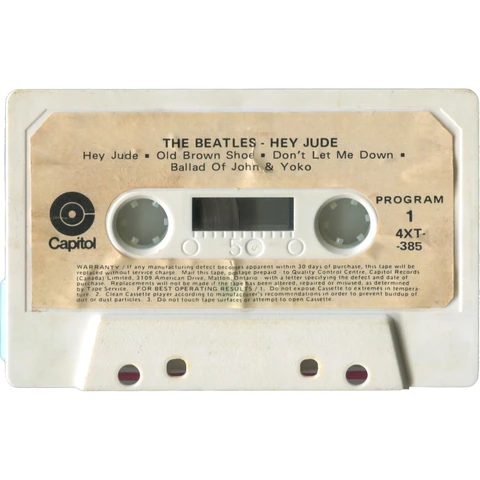
1. From mid-1969 to 1971, Capitol of Canada subcontracted its tapes to Ampex of Canada, who duplicated and assembled them on off-white shells with white paper labels with either the Apple or Capitol Target logo.
2. In 1970, Capitol opened its own tape production plant in a leased building near their offices, then moved into the Malton site (3109 American Drive) the following year, officially launching its production in-house where it moulded its own shells. The Ampex contract seems to have ended with that move, around mid-1971. These tapes were first featured in a similar off white plastic with white paper labels that now carried the Malton legal text.
From 1971 to about 1980, white and yellow paper labels were used side by side, with no clear logic as to which release got which (much like the blue and black spine J-cards). The yellow labels kept the old Capitol Records (Canada) name and the Malton address throughout, even after the company officially became Capitol Records-EMI of Canada in January 1974 and its J-cards moved to the now famous Mississauga address (Malton was a suburb of Mississauga, so the "Malton and Mississauga plants" are in fact the same facility). The white labels exist with both texts: the Malton one from 1971, and the new Capitol-EMI text with the Mississauga address from 1974 (see Cassette Shells below). A few later Apple tapes carry yellow labels with the new Capitol-EMI name, but these are exceptions rather than a trend. Paper labels stayed in use until about 1980, when they were replaced by shells with the text printed directly on the plastic in either black or silver ink.
The Capitol Mississauga plant produced all of Capitol's cassettes and 8-tracks (source: RPM, 25 June 1977), and kept making cassettes long after the facility stopped pressing vinyl in July 1984. Tapes were actually produced in Mississauga until late 1994, when the pressing plant started focusing primarily on CD production (pressing the first Anthology CDs).
3. The tape manufacturing duties were then offered to Cinram, in Scarborough (Ontario), who made the last Canadian Beatles cassettes until 2001, all featured on clear shells.
* Malton and Mississauga are the same plant at 3109 American Drive: the address changed in January 1974, when the company became Capitol Records-EMI of Canada.
There are two main elements to pay attention to when identifying a Canadian cassette (and they rarely changed in synch): the J-card (the printed card in the case) and the shell (the plastic cassette itself, with its labels or printed text).
The J-card designs fall into ten main series, described below. The shells, on the other hand, follow a different timeline, described further down (see Cassette Shells).
The figure below places both on the same time scale, with grey bands showing who made the tapes in each designated period (USA, Ampex, Capitol, Cinram). Dotted lines mark two landmarks that help date a copy: the advent of the Canadian SDR series (1982) and the beginning of the uniquely Canadian colour J-card series (1985).
The timeline is not 100% definitive since there still remains some odd grey areas, but the picture remains clear enough to illustrate the heart of the evolution of Beatles cassette production in Canada. Example of grey areas include some titles that stayed much longer on one design than others, some were only issued on specific designs, and blue and black spine cards were often available at the same time (some Apple titles remained on the blue spine until the early 1980s). Same for white and yellow paper labels. The blue spine cards, printed from USA artwork, may simply have been generic cards used alongside the newer Canadian black spines, or leftover stock. Reasons for these oddities are still unknown, but most dates here are based on documented copies; if you have information that can help detail, clarify or rectify this archive, please contact us through the CONTACT page.
Below are details on the ten main series of tapes produced in Canada between 1969 and 2001, all of which have their (many!) "sub-variations":
1. Blue Spine
Early cassettes had a blue spine and paper labels on a white plastic shell. Blue Spine tapes are found until around 1982 in some cases, with white or yellow paper labels (used side by side through the 1970s, until around 1980), and printed shells afterwards (see Cassette Shells below). This first series of tapes overlapped with the black spine series, without any insight as to what decided what titles were blue vs black spine releases. Some titles switched to the black spine at some point, while others stayed on the blue spine until 1982.
Early tapes prior to mid 1969 were imported from the USA and seem to be found without the three white bars (TBC). After this point, Canadian manufactured tapes were introduced with three white bars on the spine, and although these early tapes still retain the "MADE IN USA" stamped in the shell, they were most likely made in Canada from US moulds.
2. Black / Light Blue Three Bars
Black spine tapes with three bars (2A) were found early (as early as 1970 with the release of Hey Jude) and overlap with blue spine releases. It is not known what made a release blue or black spine. They too had paper labels (white or yellow, used side by side through the 1970s) on a white plastic shell. Although the design later changed to the "AB Squares" format (see 3), some albums remained on this variation until 1982.
Light blue spine tapes with black bars (2B) seem to have been found around 1975-1978, when the AB Square format was introduced, and were used for tapes sold at a lower mid-price point. They are similar in design to the black spine tapes and were available simultaneously starting approximately in 1975.
3. Black / Light Blue AB Square
Black spine tapes with the AB Square design (3A) appeared after the company became Capitol Records-EMI of Canada in January 1974 (their J-cards carry the Mississauga address), and are first found with yellow paper labels. These black spines were used quite extensively, until around 1982 when the SDR format became standard. Light blue cards with AB squares and 4N numbers (3B) coincide with the Green Budget label reissues from around 1980-1982; these were used for tapes sold at a lower mid-price point and were released on a similar timeline as the black AB Square.
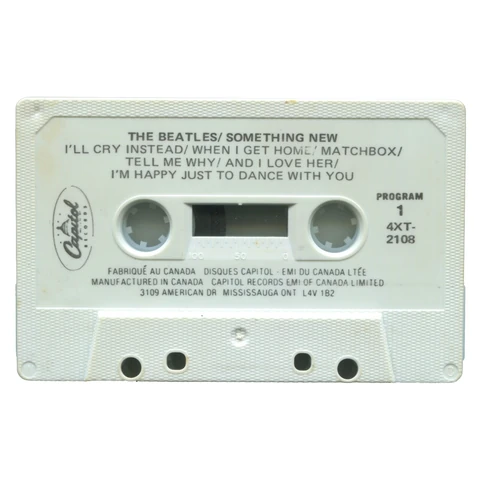
These J-cards carry the new Mississauga address, but the paper labels inside still use the old Capitol Records (Canada) name and Malton address, as Beatles and Apple paper labels did until about 1980 (see K7.2108.3A.1). By then the tapes were all made at Capitol's own tape plant (the Ampex contract having ended in 1971); printed shells replaced the paper labels around 1980.
4. SDR Tapes
Black and yellow SDR tapes (4A), a format unique to Canada, were found from 1982 to early 1983, when the SDR name gave way to the XDR name used by Capitol and EMI. SDR was not a premium line: it replaced the regular issues as the new duplication standard of the plant. These are found with white or black shells with printed text. Light Blue SDR tapes (4B) appeared at the same time and were used for tapes sold at a lower mid-price point, focusing for example on some solo releases as well as compilation albums, while the black SDR tend to focus more on the core catalogue. These cassettes were manufactured at the Capitol Mississauga pressing plant.
5. Black and Yellow / Light Blue
Black and yellow spine tapes (5A) were found for a short while after the SDR tapes, after the SDR name was replaced by XDR in early 1983, and seem to be a transitional design before Color J-card tapes appeared around 1985. Most have the period-correct "Capitol-EMI" legal text, while some (later?) copies have an MPL / Under License text. Light blue cards with no bars and 4N numbers (5B) coincide with the Green Budget label reissues from the mid 1980s; these were used for tapes sold at a lower mid-price point and were issued simultaneously with the yellow and black card tapes, from 1983-1985. These cassettes were manufactured at the Capitol Mississauga pressing plant.
6. Color J-card 4XT Series
The Color J-card design introduced around 1985 was unique to Canada and is the series that was produced for the longest period of time, between 1985 and 2000. It is also the series that has seen the most variations (4X number, C4 number, XDR, Apple logo and gold UK formats). Early tapes feature the "80s computer font", after which the typeset changed to a more traditional "Times New Roman font" in the late 1980s. Please note that white shells were also used sporadically in the late 1980s. These cassettes were manufactured at the Capitol Mississauga pressing plant.
7. Color J-card C4 Series
The C4 numbering appeared around 1991, while bar codes were introduced shortly after. Tapes that mention "EMI Music Canada" would be from after 1993, and most likely between 1995 and 2000. There are many subvariations, notably, with / without bar codes (7A, 7B), XDR (7C) or found with the Apple logo (7D, 7E). White shells were also used sporadically around 1994-1995, after which clear shells were introduced in 1995. These cassettes were manufactured at the Capitol Mississauga pressing plant until late 1994, when the plant turned to CD production and the cassettes were sent to Cinram.
8. GOLD J-card C4 Series
These were used between 1988-1995 and were used mainly for UK format albums (like the CLJ vinyl record series). There is also an instance of McCartney's RAM album on the gold card, but this seems to be a rare occurrence besides the Beatles UK album series. These cassettes were manufactured at the Capitol Mississauga pressing plant. These were featured without the XDR logo (8A), with the XDR logo added (8B), or with both the XDR logo and an Apple logo on the J-card (8C).
9. EMI Clear Shell, 4T 0 7777 Series
These are the last Canadian tapes to have been produced, and only a handful of titles have been documented. They were produced between 1995 and 2000. They are found in either regular Color J-card cards (9B) featuring the EMI MUSIC CANADA logo, or on the UK format gold cards (9A). These cassettes were made by Cinram, in Scarborough (Ontario), to which EMI sent its tape production in late 1994.
10. Apple 2.0
When Apple was reborn and started to produce new material, the Color J-card design was dropped for these new releases (while the Color J-cards remained for previous release reissues), and EMI adopted a custom design approach. These are found in Canada between 1993 (starting with the remastered reissue on the red and blue albums) and 2001 (ending with the "1" album cassette issue) when EMI stopped producing cassettes domestically and started importing them instead (cassette sales were becoming marginal at this point). These cassettes were made at Capitol's Mississauga plant until late 1994, then by Cinram.


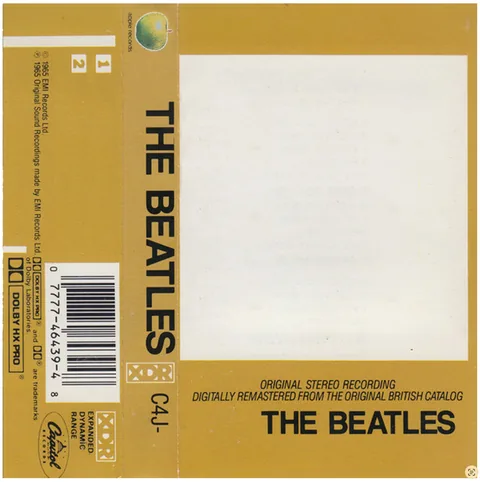


The shell tells as much as the J-card, and often more. A Canadian Beatles cassette went through four makers' hands: the USA (imported copies, until mid-1969), Ampex of Canada (mid-1969 to mid-1971), Capitol itself, at its own tape plant in Malton / Mississauga (mid-1971 to late 1994), and finally Cinram (1995 to 2001). The colour of the plastic is a first clue, but not a proof: Ampex shells are off-white (an ivory grey), Capitol's own shells were also off-white or bright white, butterscotch (light or dark) or, later, black, and Cinram's are clear. The labels are the safer clue for the early years: Ampex labels carry no Capitol legal text, while Capitol's own labels carry its warranty text, addressed to Malton (and, on some white labels from 1974, its new legal text with the Mississauga address). White and yellow paper labels were then used side by side until about 1980, before the text was printed directly on the shell around 1980.
A few notes. A single J-card design can house two or three different shells, and the same shell turns up under several J-card designs, so the shell and the card should always be read together. Also, shells can be found with different surface textures; these seem to have been used randomly and interchangeably, so there is no clear timeline for the different shell types (texture) being used.
1. Imported (USA), White Labels
Before mid 1969, the Beatles cassettes sold in Canada were imported from the USA. These are white shells with "MADE IN U.S.A." moulded at the top, and white paper labels carrying the oval Capitol (dome) logo with the word CASSETTE under it.
2A. Ampex, Off-white Shell, White Labels (Target Logo)
From mid 1969, the Canadian-made tapes carry white paper labels with the Capitol target logo at the left, the programme and catalogue numbers at the right, and the artist credit under the tape window (see The Early Beatles, 4XT-2309). The first ones were made by Ampex, to which Capitol of Canada subcontracted its tape production until mid-1971, and sit on off-white shells. Ampex labels are easy to spot: they carry no Capitol legal text. Some early 1969 shells still carry the "MADE IN USA" moulding (see Blue Spine above), as they were most likely made here from US moulds.
2B. Ampex, Off-white Shell, White Labels (Apple Logo)
Apple titles got their own white paper labels, with the Apple logo at the left (see Abbey Road, 4XT 383, and Let It Be, 4X0 6351). Like the target logo labels, they carry no Capitol legal text and sit on the same off-white Ampex shells. Paper labels with Apple logos did not "follow" Capitol logo labels, but were simply used simultaneously to designate Apple releases.
3. Capitol, White Shell, White Labels, Malton Text
From mid-1971, the same white labels (target or Apple logo) appear on tapes made at Capitol's own tape plant in Malton, now with the Capitol warranty text addressed to Malton (see Hey Jude, 4XT-385), on Capitol's bright white shells. Some Capitol copies from 1971 and 1975 have been verified on US moulds, and a 1977 release on a Canadian mould, which suggests Capitol kept US moulds for a few years before moving to Canadian ones. White paper labels with the Malton text stayed in use until about 1980, side by side with the yellow labels and with no clear logic as to which release got which. Some Apple titles from 1973 onward are documented with Capitol target or dome logo labels instead of Apple ones (the 1962-1966 and 1967-1970 albums, for example), and one is even documented with paper labels on a black shell, around 1974.
4. Capitol, Off-white Shell, White Labels, Mississauga Text
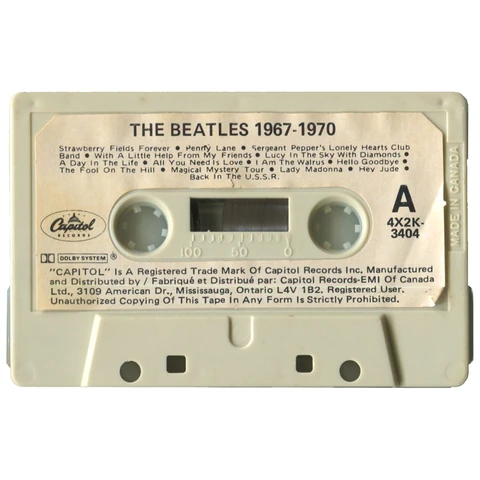
From 1974, once the company had become Capitol Records-EMI of Canada, some white labels carry the new legal text with the Mississauga address ("Manufactured and Distributed by / Fabriqué et Distribué par: Capitol Records-EMI Of Canada Ltd., 3109 American Dr., Mississauga, Ontario") and the oval Capitol logo, on off-white shells (see The Beatles 1967-1970, 4X2K-3404). These were used from about 1974 until the printed shells took over, around 1980, alongside the Malton text labels (3 and 5), which stayed in use over the same years.
5. Yellow Labels, Malton Text
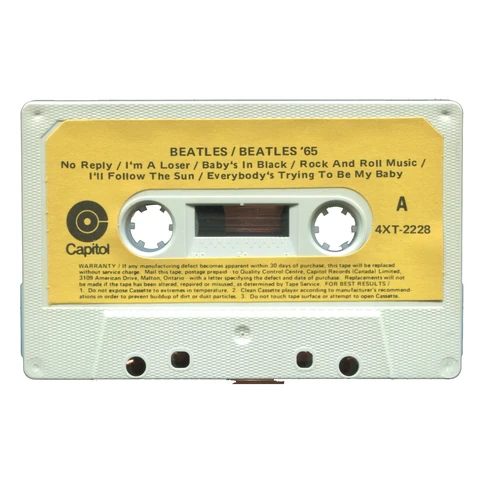
Yellow paper labels appeared in the early 1970s, on Capitol's off-white, white and sometimes butterscotch shells (see K7.2108.3A.1). They were used alongside the white labels until the printed shells took over, around 1980. On Beatles and Apple tapes, they carry the old Capitol Records (Canada) name and the Quality Control Centre address in Malton (see K7.2228.1.1) until about 1980, even though the company officially became Capitol Records-EMI of Canada in January 1974, so the address on the label cannot date a copy on its own. Some J-cards already carry the new Mississauga address while the labels keep the Malton one (see K7.2108.3A.1). A few later Apple tapes carry a yellow label with the new Capitol-EMI name (still without the Mississauga address), but this is an exception rather than a trend.
6. White Shell, Printed
Around 1980, the paper labels gave way to text printed directly on the shell, along with a bilingual manufacturer line and the Mississauga address. The printed shells came in white (6), butterscotch and dark butterscotch (7) with black print, and in black with silver print (8), and these seem to have been used interchangeably. On the titles documented with both, the white copy tends to be the earlier one, with the black shell turning up a year or so later (see K7.2228.3A.2 and K7.2228.3A.3). The white printed shells did not disappear afterwards. They turn up sporadically (and seemingly at random) alongside the black shells, on the SDR tapes of 1982 and early 1983, the black and yellow series of 1983-1985 and the Color J-cards until the mid 1990s. Most use the same plain, regular font as the black shells (6A).
The robot font layout is found on white shells as well (6B; see K7.6051.4A.2, K7.6063.4A.2 and K7.6054.6.2), turning up as randomly as the other white shells described above.
7. Butterscotch Shell, Printed
Butterscotch is a darker Capitol plastic, not to be confused with the paler off-white shells. It is found with black print in two shades, a lighter butterscotch (7A) and a dark butterscotch (7B), used as interchangeably as the white and black printed shells (Rarities, a 1980 release, is one example).
8. Black Shell, Printed
Black shells with silver print appeared around 1981 and soon became the standard Canadian shell, found on the last blue and black spine tapes, on the SDR series and on most Color J-card tapes until 1994. The first ones use a plain, regular font (8A), with the oval Capitol logo at the left, PROGRAM 1 or PROGRAM 2 over the catalogue number at the right and the bilingual Mississauga manufacturer line under the tape window (see K7.2228.1.2). This layout stayed in use on some titles well into the 1990s and returned on most of them once the robot font was dropped, around 1990. The last 4XT Color J-card tapes, made between then and the change to C4 numbers in 1991, already carry it (see K7.2228.6.1), and K7.2228.7B.1 still does in 1992, with its new C4 number.
From the SDR tapes of 1982 onward, many black shells carry a different layout (8B), set in the distinctive "futuristic robot font" (also called the "techno font"), with the Dolby logo at the left, the Capitol script logo at the bottom right and an English-only "MADE IN CANADA BY CAPITOL RECORDS-EMI OF CANADA LTD" line (see K7.6051.4A.1 and K7.6051.6.1). It is found throughout the 4XT Color J-card years, until about 1990, while other titles kept the regular font at the same time (both layouts seem to have been used simultaneously).
Around 1994, with the return of the Apple logo on the J-cards (7D/7E), the black shells changed again. The robot font made way for a classic serif font (8C), with the Apple logo printed at the left, a big programme number and the XDR logo at the right, and a "Made in Canada. Distributed by Capitol Records - EMI of Canada" line (see K7.6054.6.3). This was the last black shell design, and among the last tapes made at Capitol's own plant: in late 1994, the Mississauga facility turned to CD production and the cassettes were sent to Cinram, where the same serif layout carried over to the first clear shells in 1995.
9. Clear Shell (Cinram)
Clear shells were introduced in 1995 and carried the last Canadian cassettes, until EMI stopped producing tapes here in 2001. They were made by Cinram, in Scarborough (Ontario), to which EMI sent its tape production in late 1994, when the Mississauga facility was retooled for CD production. They are found with the EMI Music Canada Color J-cards (9B), the gold UK format cards (9A) and the Apple 2.0 releases (10). Black shells were still used for a short while in 1995.
Again, these dates are educated estimates based on the documented copies, and different shells were often used simultaneously (and seemingly interchangeably). Any information that can help refine this timeline would be appreciated.
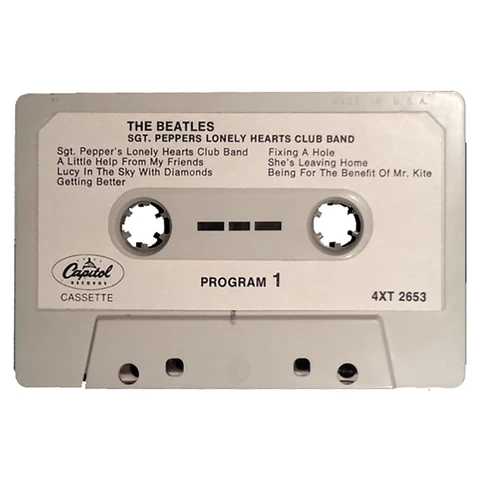
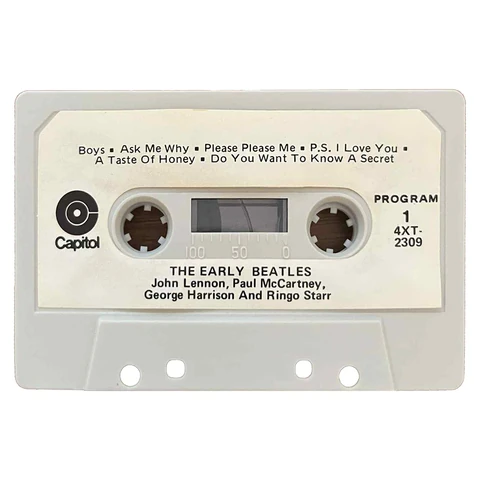
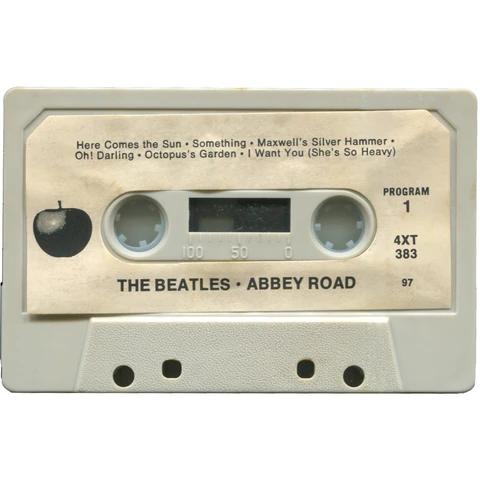
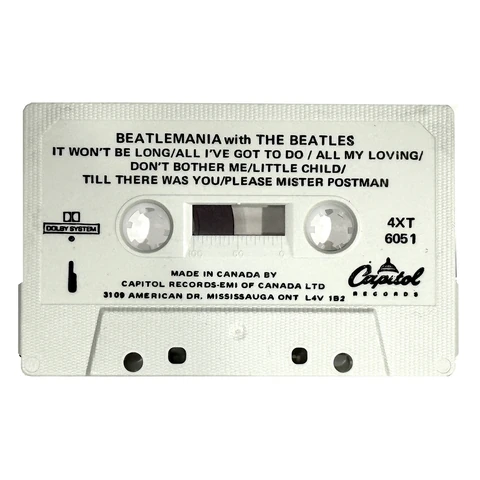
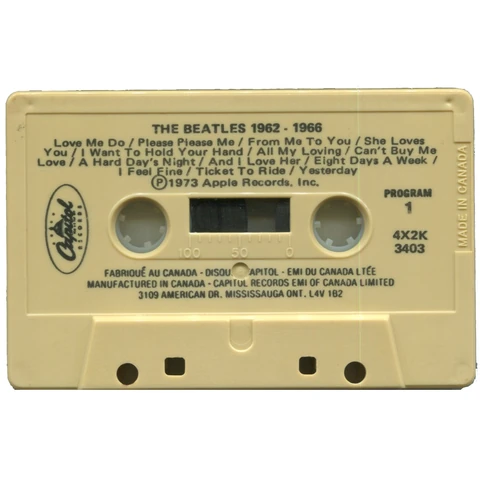
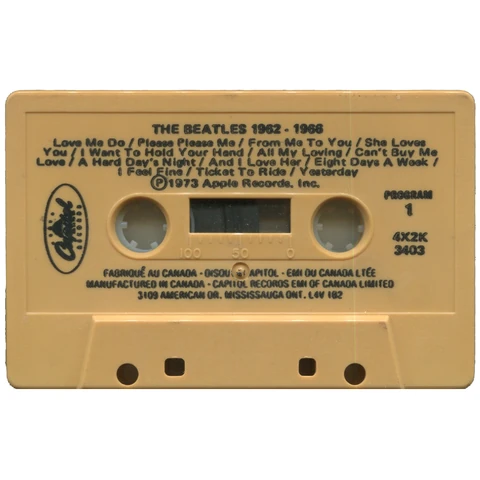
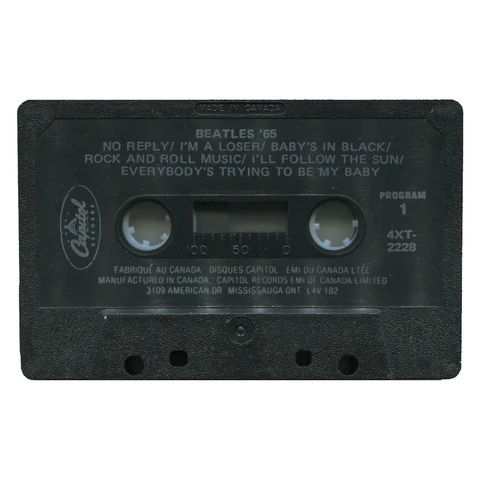
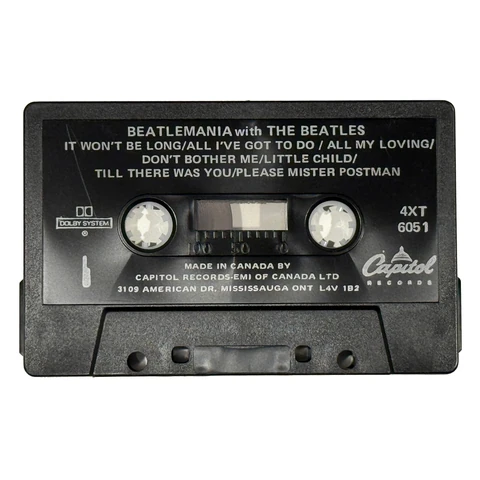
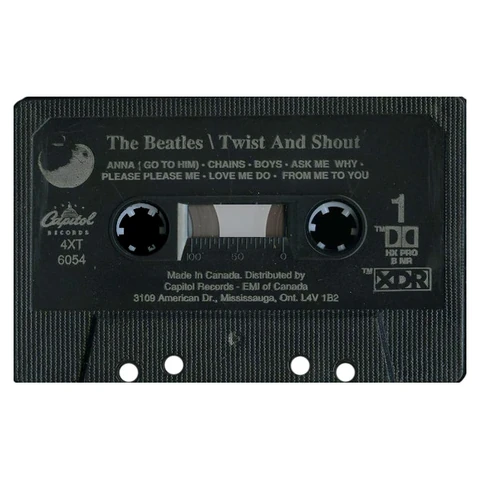
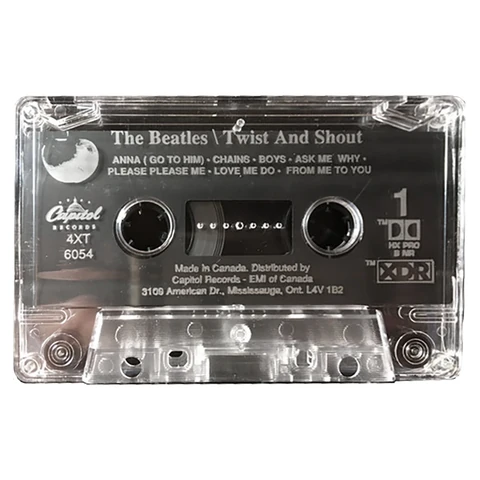
Capitol's black shells did not all come from the same mould. The model, the shape and the surface texture changed over the years, and many seem to have been used at the same time, interchangeably, so it is difficult to date the different models with certainty. Just the shells with the robot font feature 5 different models that were seemingly used between 1982 and 1990.
The picture below shows eight Capitol shells; the models seen here are 1. ribbed (horizontal ribs across the whole shell), 2. pebbled grain, 3. pebbled grain with round bosses at the two bottom corners, 4. smooth shell with five screws, 5. vertical line pattern, 6. horizontal line pattern, 7. smooth with a rectangle at the bottom, and 8. dotted. These are simply a sample as examples; there are other models with subtle differences not documented here.
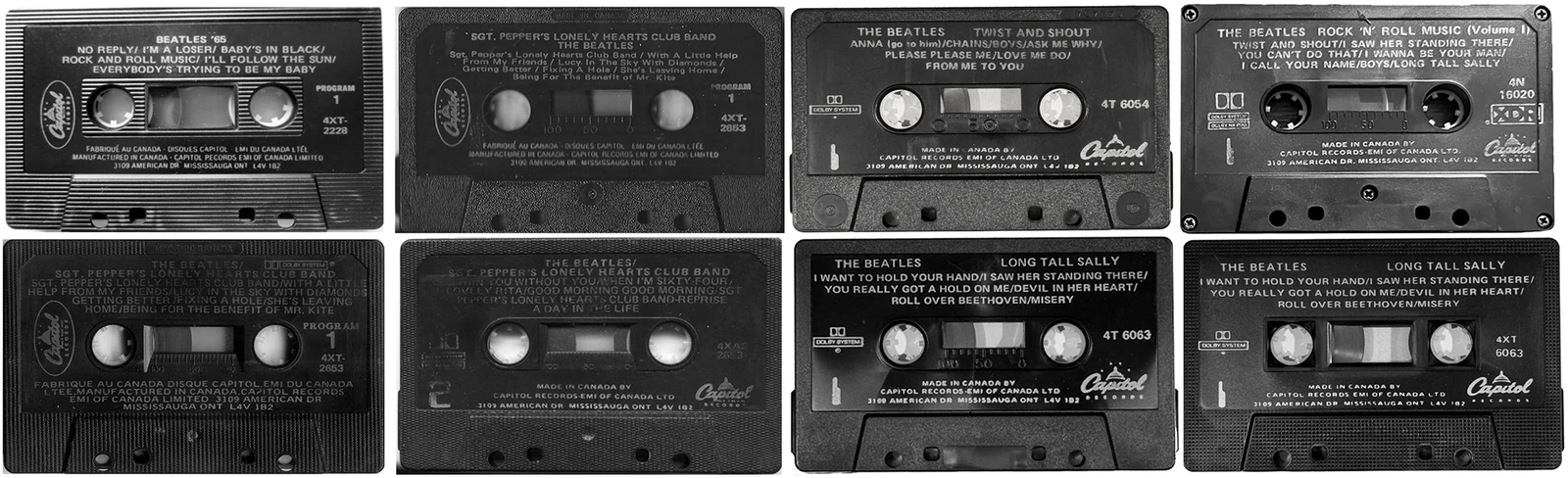
The same variations (in model, shape and texture) can be found on the white and butterscotch shells.
Entries in this archive are numbered so you can easily refer to them when trying to organize your collection. A typical variation number would be presented in an Alpha Decimal format that sequentially identifies:
As an example, the Columbia pressing of the White Album featured on the 2nd generation orange label would be numbered LP.APP101.7.1 : in other words, the LP version of the Apple album number 101 (the White Album's catalogue number), on the 7th label type (The orange 2nd gen. label), and this is the first variation of this category.
Or, the Gold Box Series Reel to Reel release of Sgt Pepper's would be numbered RE.2653.2.1: in other words, the reel version of the title with catalogue number 2653 (Pepper), from the second series of reels (Gold Box), and this is the first variation of this category.
Finally, the last clear shell cassette issue of Abbey Road would be numbered K7.APP383.9.2: in other words, the cassette version of the Apple album numbered 383 title (Abbey Road), from the ninth series of tapes (Color J-card XDR Clear Shell), and this is the second variation of this category.
...and so on.
This allows anyone who has learned the numbering system to identify with precision any variation, just from its ID number. This system does not replicate other numbering systems (e.g. Spizer, or Valiquette), but has been tailored to the structural logic of this archive. For detailed explanations of label variations and their relative numbers, visit the FORMATS page from the main menu.