← Sing A Song With The Beatles Variations List
Sing A Song With The Beatles
LP.6114.1.2
First Stereo Pressing, No Brackets
12 April, 1965 - July 1966
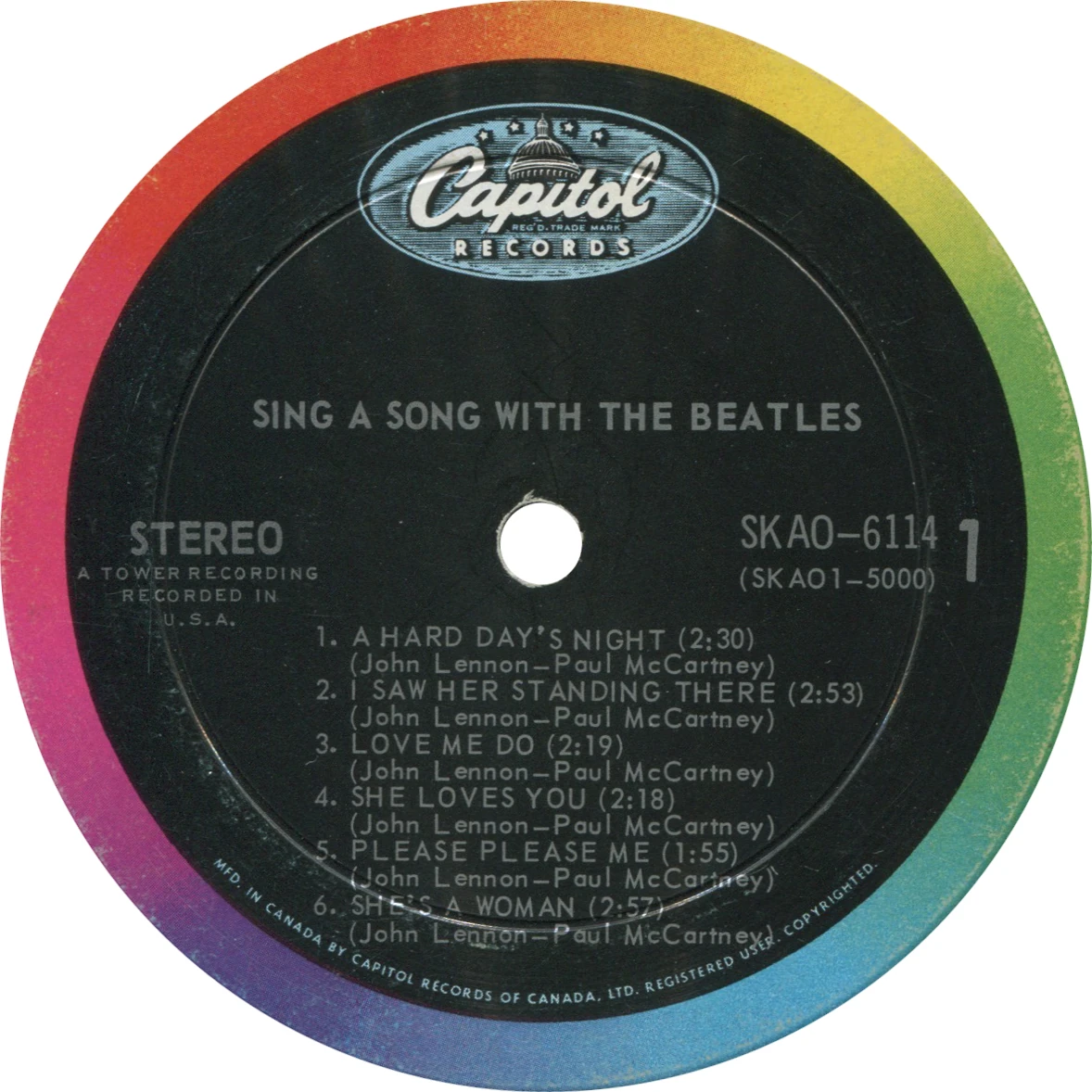
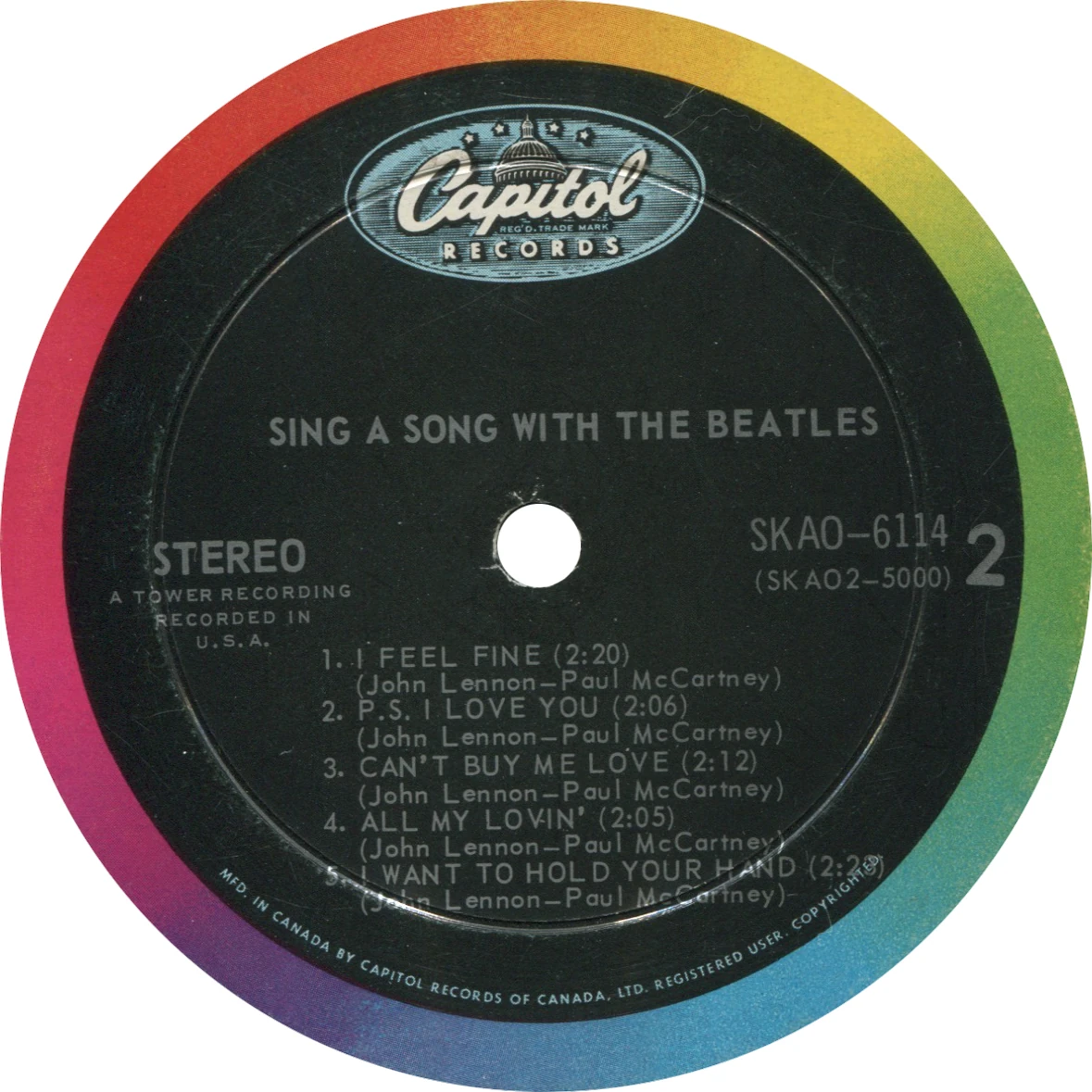
LP.6114.1.2 is the first stereo pressing of Sing A Song With The Beatles, an instrumental sing-along album on which the Beatles do not play. It was released around 12 April, 1965, alongside the mono edition (LP.6114.1.1), on the stereo rainbow no brackets label (catalogue number SKAO-6114), with the Tower "STEREO" banner on the front cover.
Availability
This variation was available from 12 April, 1965 until July 1966 (for approximately 15 months), when the perimeter print changed to a version with brackets around the word CANADA (see LP.6114.2.2). Hemmingsen believes the stereo editions of the albums released in the first half of 1965 (this one, Beatles'65 and Beatles VI) were made in small numbers, probably fewer than 5,000 copies each, perhaps on special order only (source: P. Hemmingsen, The Beatles’ Canadian Discography part. 2). Add the poor sales of the album to that, and this first stereo pressing is a hard one to find.
General Information
Sing A Song With The Beatles is NOT a Beatles record, even though nothing on the jacket says so. The Beatles do not play or sing a single note on it; the eleven Lennon-McCartney hits were re-recorded by Capitol studio musicians, with no vocals at all, so that fans could sing the words themselves (the front cover promises "Instrumental Background Re-creations of Their Big Hits" and "Printed Lyrics and Chord Symbols Included"). The arrangements were "transcribed & conducted by Jimmie Haskell" (as the inside of the jacket puts it), a Capitol USA arranger already known here for his film and TV theme singles, and the album was produced by Jim Economides, who had worked on Capitol's surf and hot rod albums (source: P. Hemmingsen, The Beatles’ Canadian Discography part. 2).
In the USA, it was the very first album on Tower, the subsidiary label Capitol had just launched and named after its round tower building in Hollywood (catalogue number (S)KAO-5000). Capitol of Canada never used the Tower label. It released some Tower albums on its own 6000 series instead (Ian Whitcomb and, a few years later, Pink Floyd took the same route, with their singles going to the 72000 series), so this one came out here as (S)KAO-6114, on the regular Capitol rainbow label, around 12 April, 1965 (the same week as the Ticket To Ride single). That made it part of Capitol of Canada's 6000 series, alongside Beatlemania! With The Beatles, Long Tall Sally and Twist And Shout (and, a few years later, the Let It Be box set, SOAL-6351). The label still tells where the music came from, with "A TOWER RECORDING / RECORDED IN U.S.A." printed on its left side.
With colour photos of the four Beatles on the front, their name in large letters and Capitol (their own label) on the disc, the album looked exactly like the real thing; the clues are all in small print (the subtitle, and a "File Uuder: Beatles Hits • Instrumental" line at the top of the front cover). The back cover does not help either, as it opens on "Here they are... instrumental backgrounds to the world's top songs just as they were recorded on the vocal hits by the world's top group... The Beatles!", which a buyer could easily read as the Beatles' own backing tracks. Hemmingsen sees it as the closest any Canadian album of the Sixties came to passing for a genuine Beatles LP, and to many buyers it was a big disappointment. Sales were close to nil (source: P. Hemmingsen, The Beatles’ Canadian Discography part. 2). Curiously, the album still stayed in the catalogue for some four years and came back twice, on the brackets label after July 1966 (see LP.6114.2.1 and LP.6114.2.2), then with a new stereo jacket after mid 1968 (see LP.6114.2.3), so it must have kept minimal sales through time, if slowly.
A Sing-Along Record, Before Karaoke
Records made for singing along were nothing new in 1965 (Mitch Miller's Sing Along With Mitch albums and TV show had made the idea popular at the start of the decade), but those came WITH the singers. This album offers the opposite, the band without the voice, an idea that would only get its Japanese name, karaoke ("empty orchestra"), in the early 1970s.
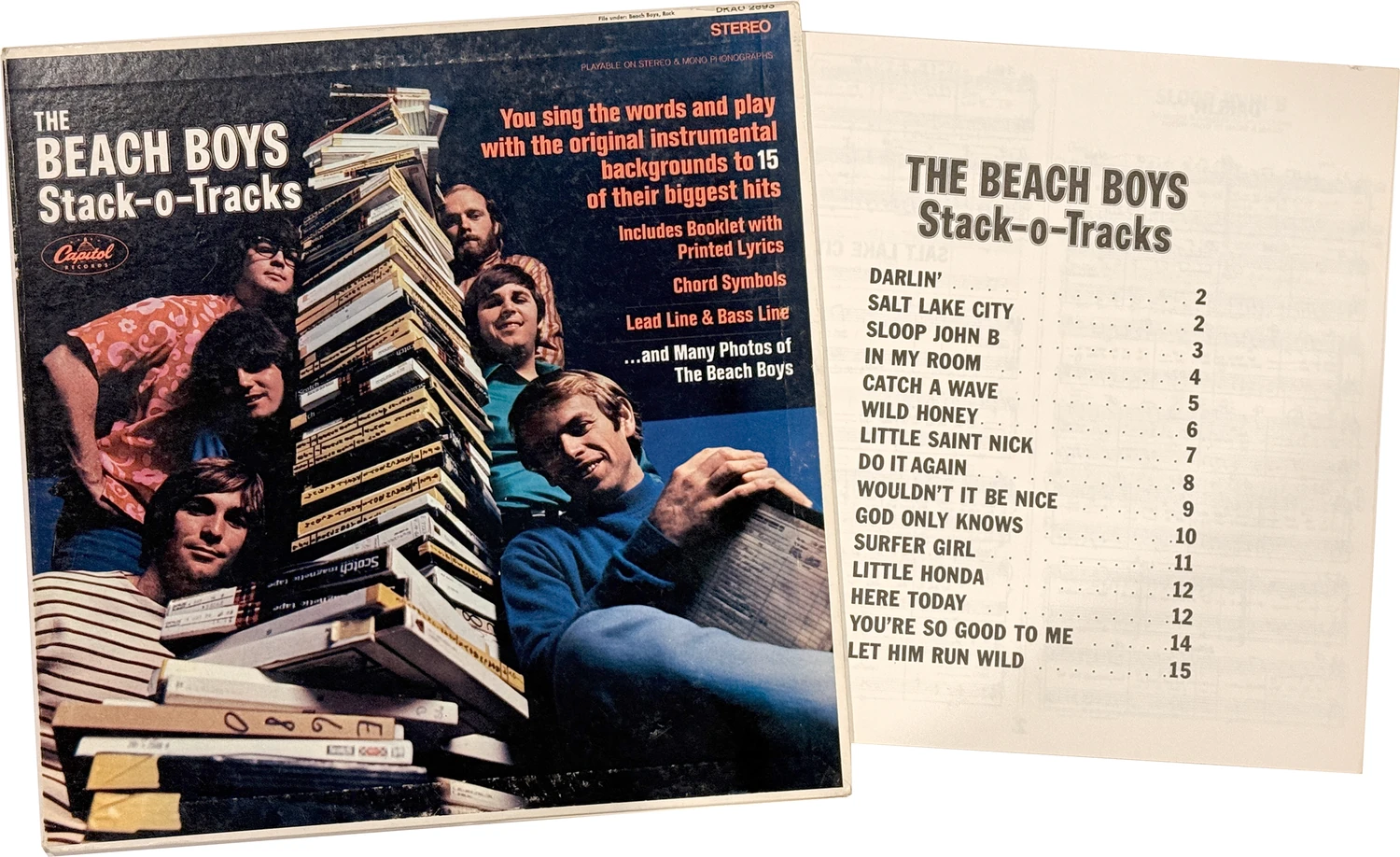
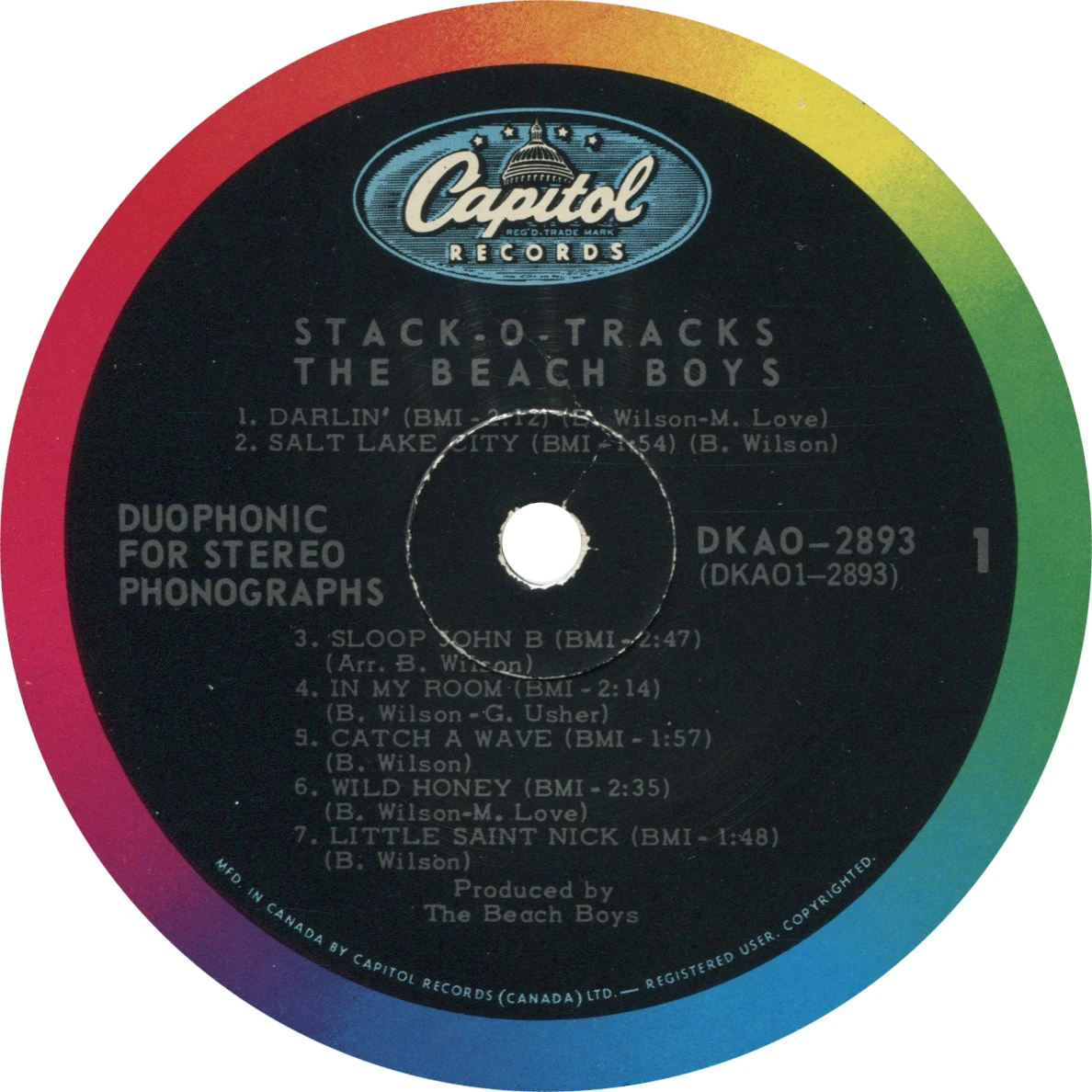
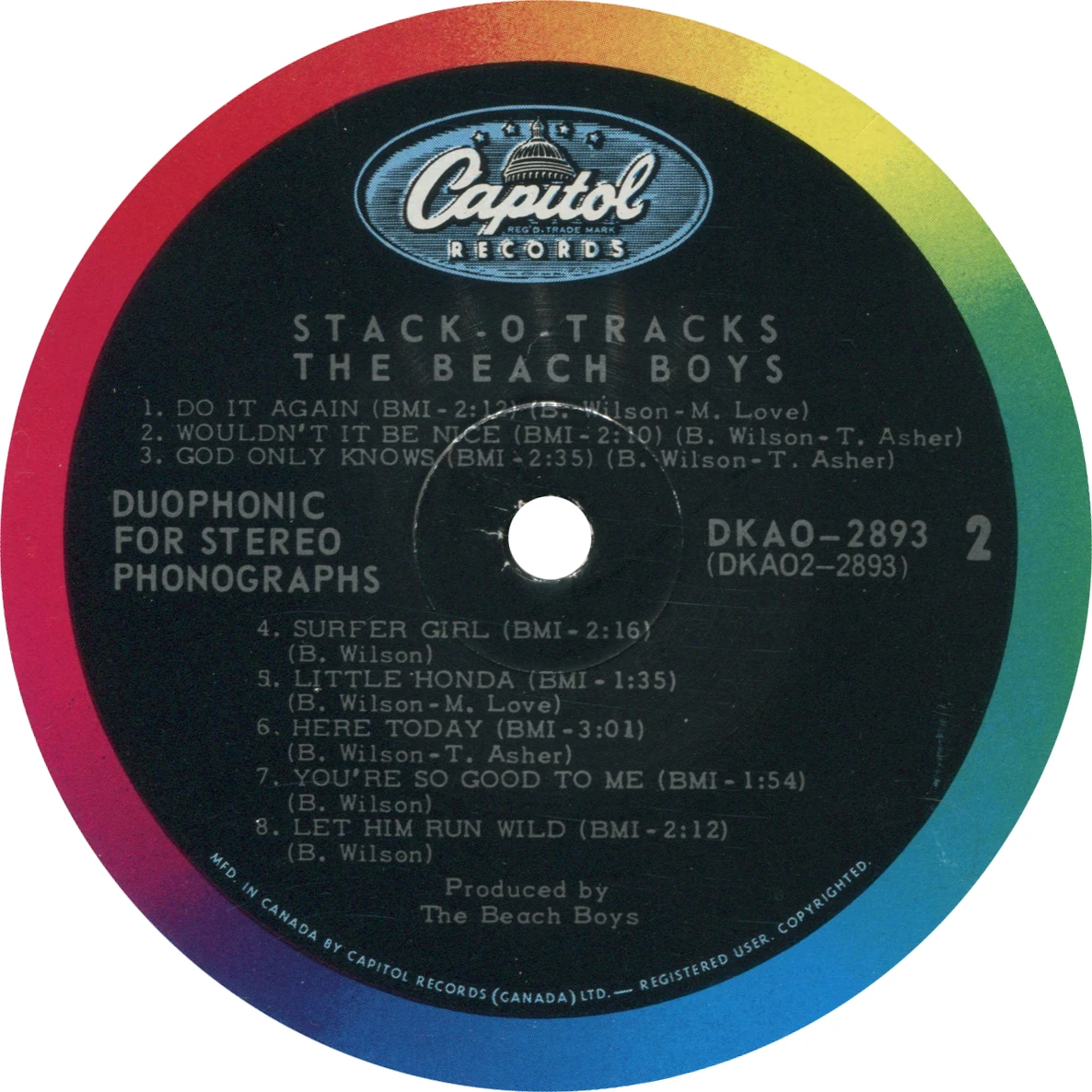
Capitol tried it again three years later with its other big group. The Beach Boys' Stack-O-Tracks (Capitol DKAO-2893, released on 19 August, 1968, and also issued in Canada) holds the backing tracks of fifteen of their songs, in a gatefold with a booklet of lyrics, chords, bass and lead lines. The difference between the two is a big one: Stack-O-Tracks is the real Beach Boys, their own studio backing tracks with the vocals left out, while Sing A Song With The Beatles is not the Beatles at all, but another band re-recording their songs. Capitol USA owned the Beach Boys' tapes, while the Beatles' tapes stayed with EMI in London, which most likely explains it. Curiously, both albums carry the same KAO prefix (K for the price code, A for a single disc, O for the special packaging; see "Reading a Capitol catalogue prefix" on the Pressing Plants page).
Pressing Information
Capitol of Canada subcontracted the RCA pressing plant in Smiths Falls (Ontario) to manufacture this batch of pressings, from plates supplied from Capitol's Scranton pressing plant in the USA. USA plates are recognized by their machine-stamped matrix numbers, and parts that originate from the Scranton pressing plant feature the triangular IAM (International Association of Machinists) logo (each American plant had its own distinctive logo).
The catalogue number of this edition is SKAO-6114, printed on the jacket and the label, and it is the number this variation is filed under. The matrix numbers stamped in the run-out tell another story: they carry 5000, the catalogue number of the American Tower edition. The plates were made for the Tower release and shipped to Canada as they were, with no new matrix numbers; only the label was printed with the Canadian number, and it still shows the Tower side number in brackets under it (SKAO-6114, then (SKAO1-5000) below). These same stampers were used on every later stereo pressing too (see LP.6114.2.2 and LP.6114.2.3); the album sold so poorly that the plates never wore out.
LP.6114.1.2 has markings as follows:
Side 1: SK1-5000-W1
Side 2: SK2-5000-A1 #2

Read together, these markings tell how the record was made: plates supplied by Capitol's Scranton plant, with side 1 cut in New York from New York tapes and side 2 cut in Hollywood from first generation Los Angeles tapes, then pressed by RCA in Smiths Falls.
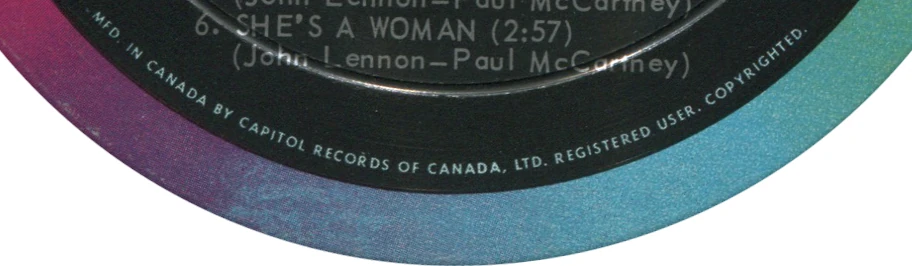
These pressings feature a 70 mm deep-groove pressing ring, a hallmark of early RCA Canadian manufacture. Labels feature the "no brackets" rainbow label (see perimeter print at the bottom of the label: "MFD. IN CANADA BY CAPITOL RECORDS OF CANADA" with no brackets around the word CANADA).
Cover
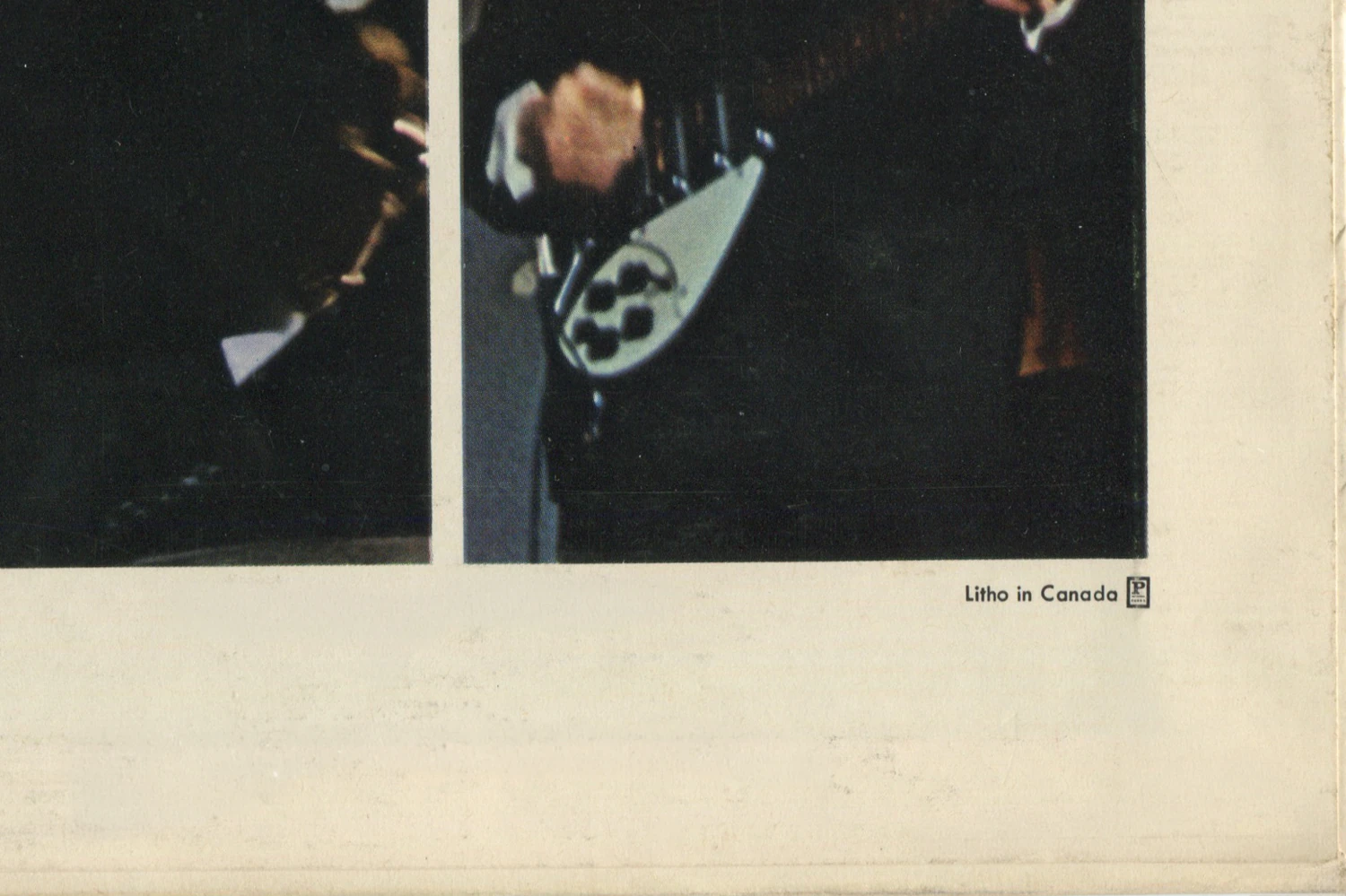
The stereo jacket is the same gatefold printed by Parr's in Toronto ("Litho in Canada" with their "P" logo at the bottom right of the front), with a Tower "STEREO" banner added above the title at the top of the front cover.
Because the artwork was designed for Tower, the mark beside the catalogue number at the top right of the front cover is a square (Tower's shape), where Capitol jackets carry a full dot on mono covers and a split dot on stereo covers. It sits next to the "File Uuder: Beatles Hits • Instrumental" line (the typo is printed on every copy) and above a "HIGH FIDELITY / THE "6000" SERIES" box with the Capitol logo.
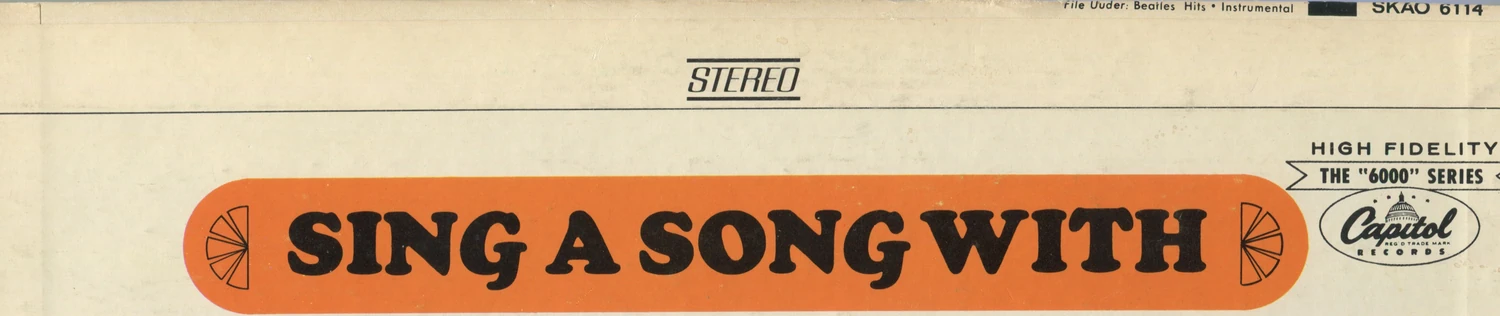
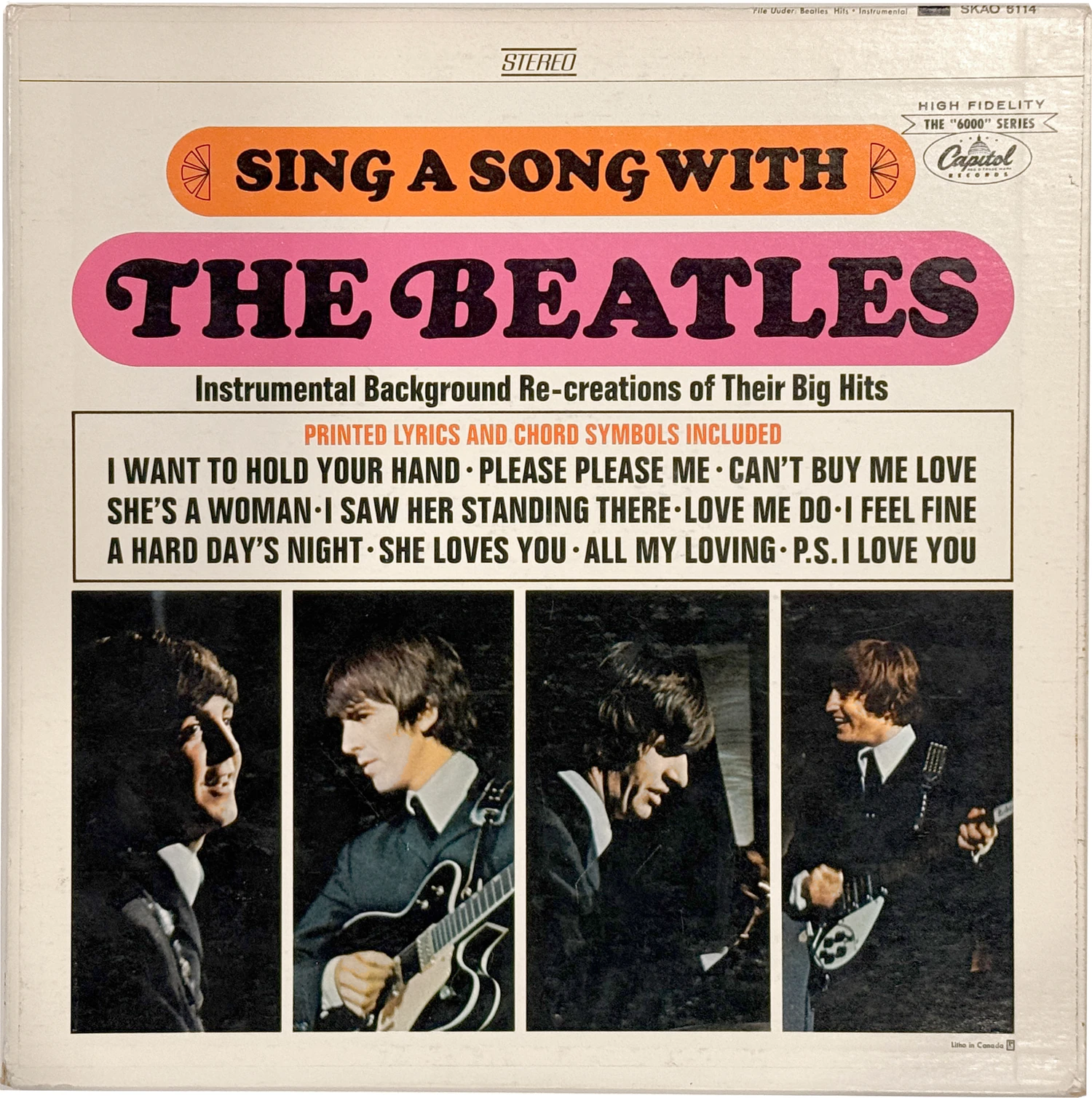
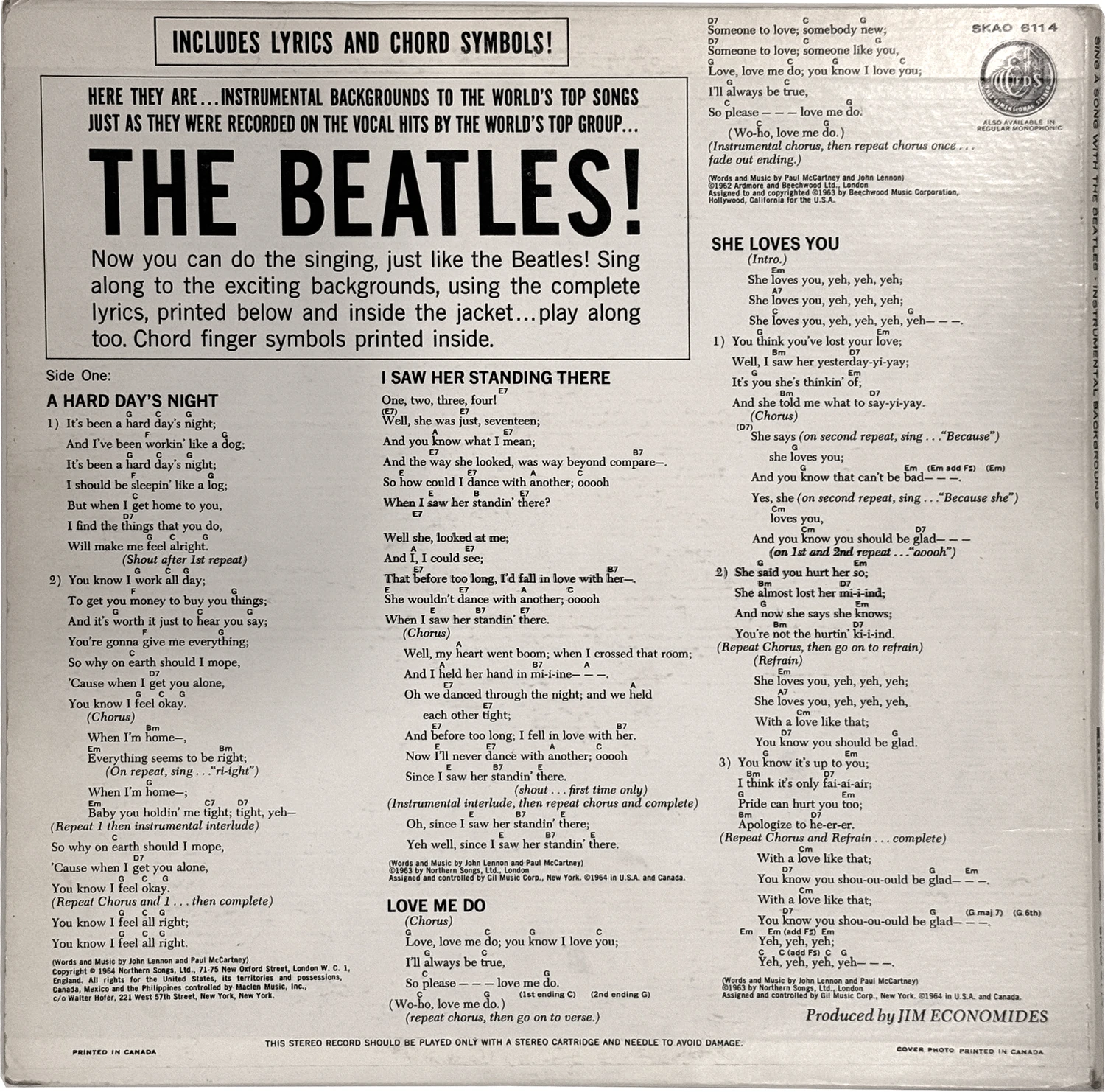
On the back, the HIGH FIDELITY RECORDING logo of the mono jacket is replaced by the round "FDS" (Full Dimensional Stereo) logo, with "ALSO AVAILABLE IN REGULAR MONOPHONIC" under it, and the bottom carries the warning for stereo records ("This stereo record should be played only with a stereo cartridge and needle to avoid damage").
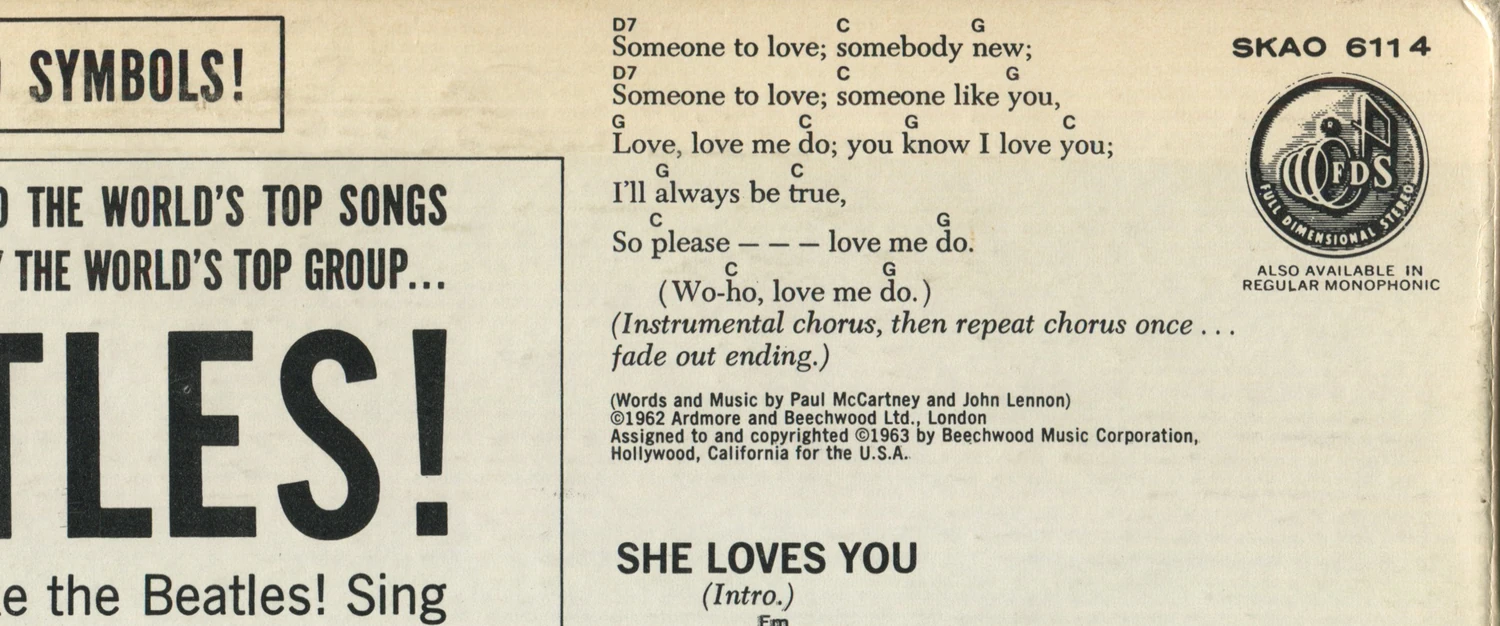

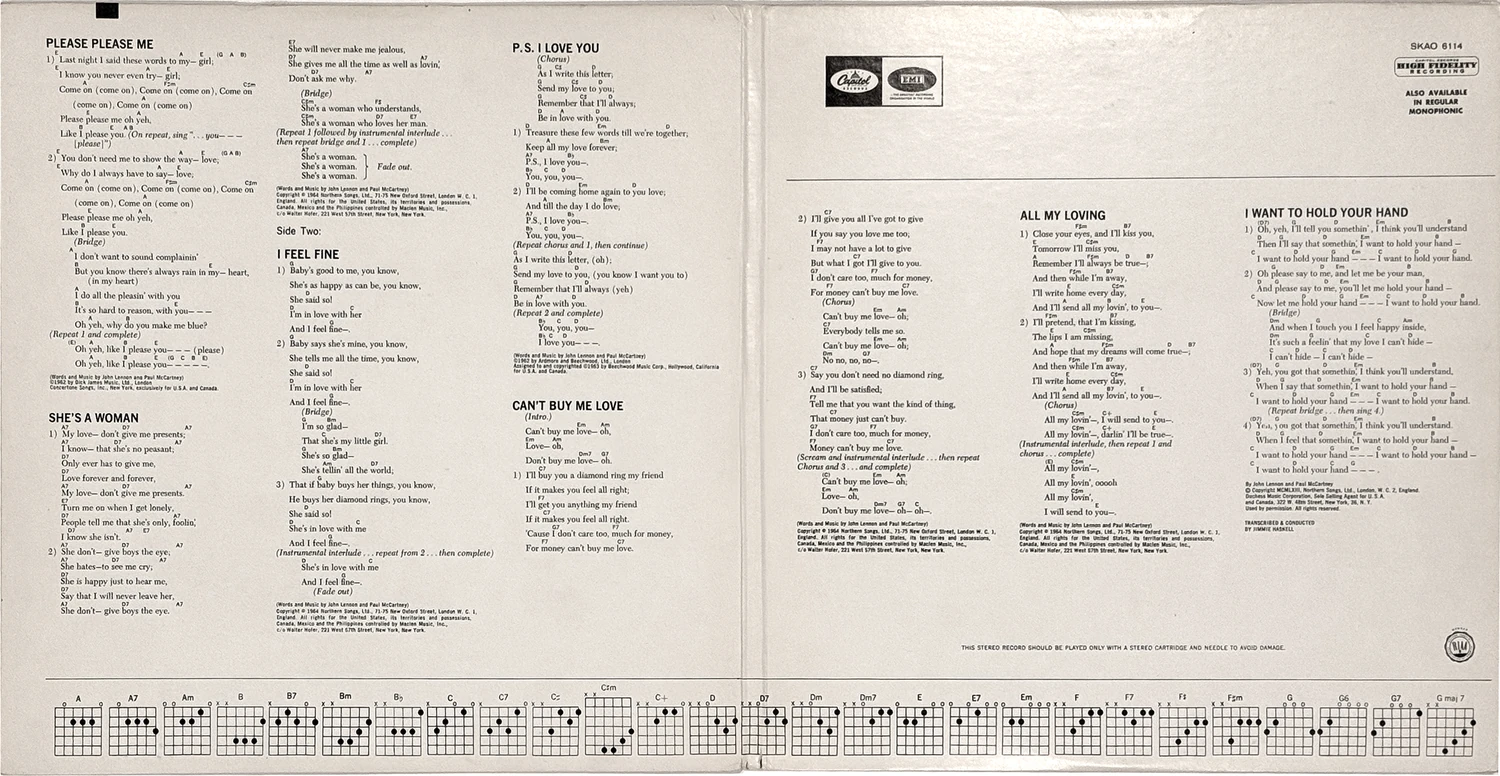
Inside, the gatefold holds the rest of the lyrics and the guitar chord diagrams, as on the mono jacket. The top right reads SKAO 6114 (KAO 6114 on the mono jacket, see LP.6114.1.1), with "ALSO AVAILABLE IN REGULAR MONOPHONIC" under a HIGH FIDELITY RECORDING logo, the inside having kept the mono jacket's logo.
Packaging
These pressings were shipped in a loose poly plastic wrap with breather holes, which let customers open the gatefold in the shop and look at the lyrics inside (source: P. Hemmingsen, The Beatles’ Canadian Discography part. 2).
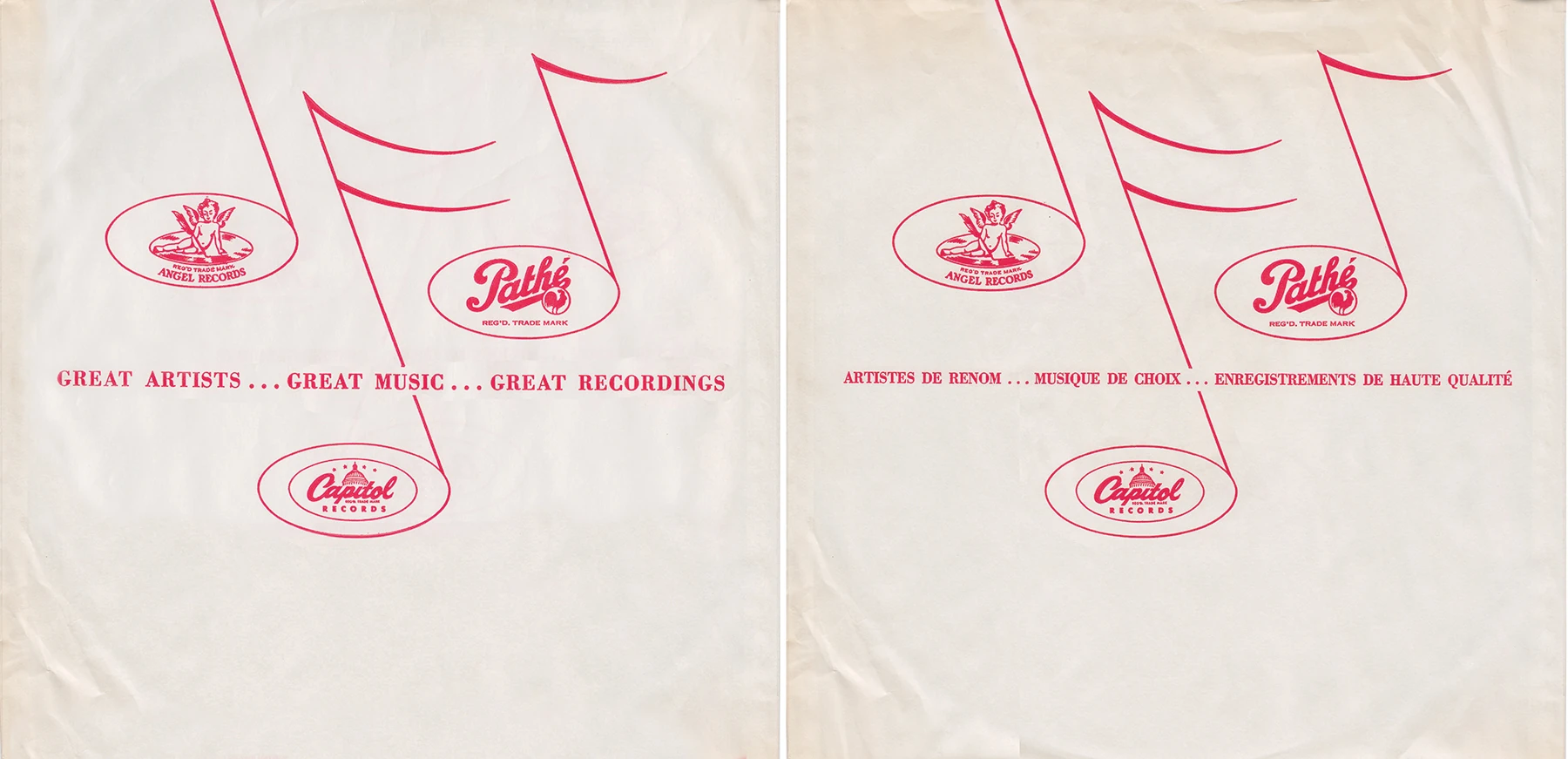
These were sold with / without a red and white Capitol / Pathé paper LP inner sleeve (apparently designed by Paul White).