
← Something New Variations List
Something New
LP.2108.1.1 | First Pressing - Mono, USA Plates
20 July, 1964 - mid 1965
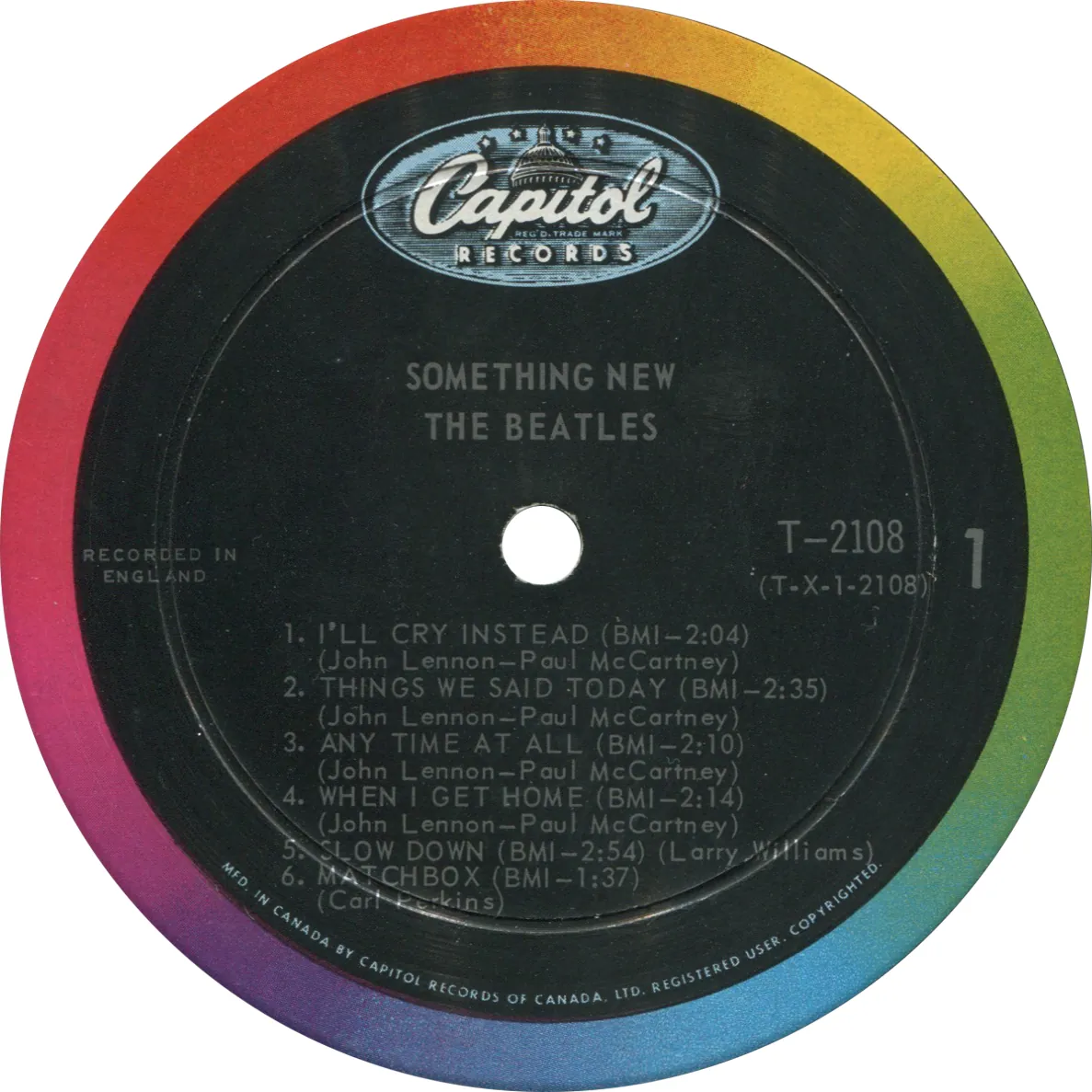
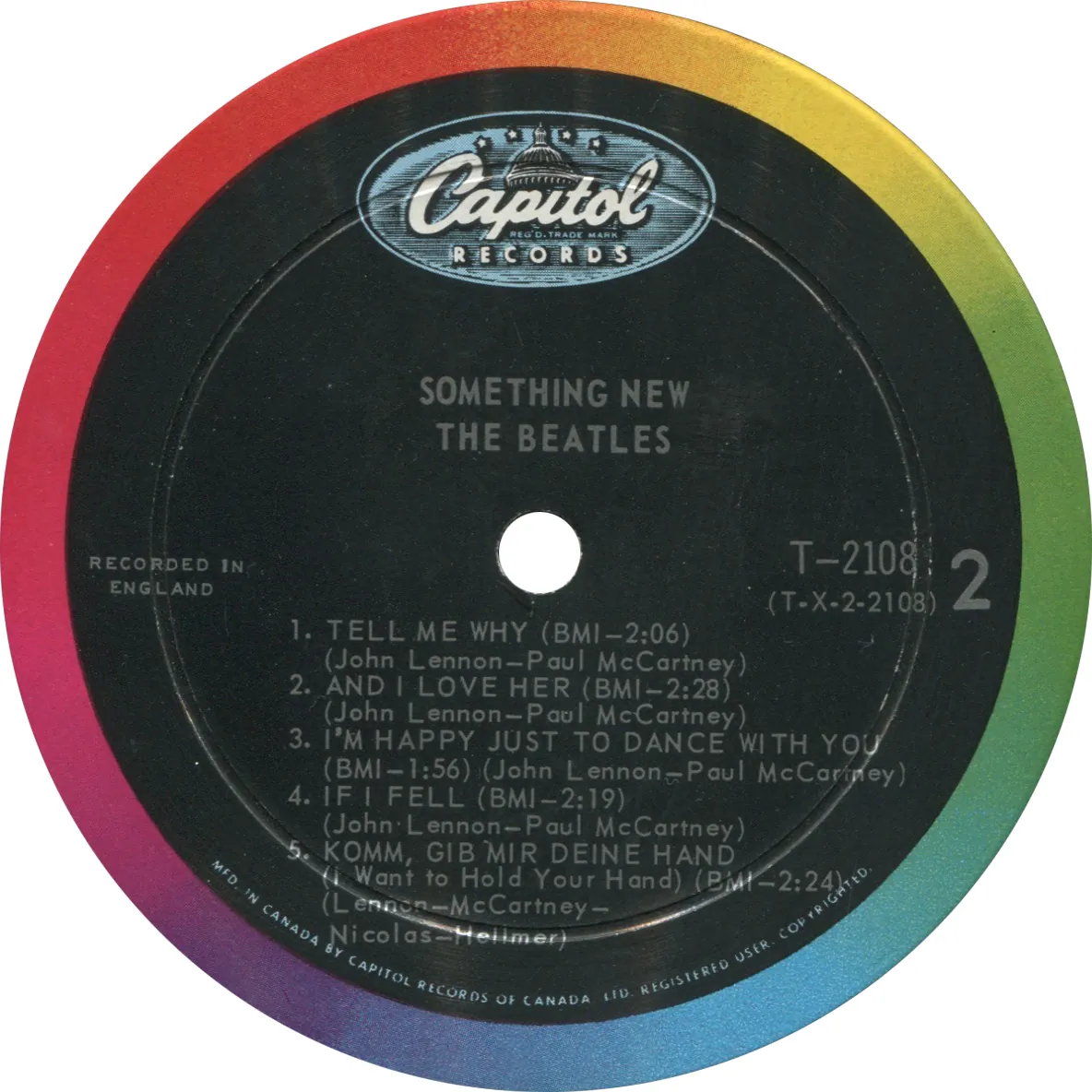
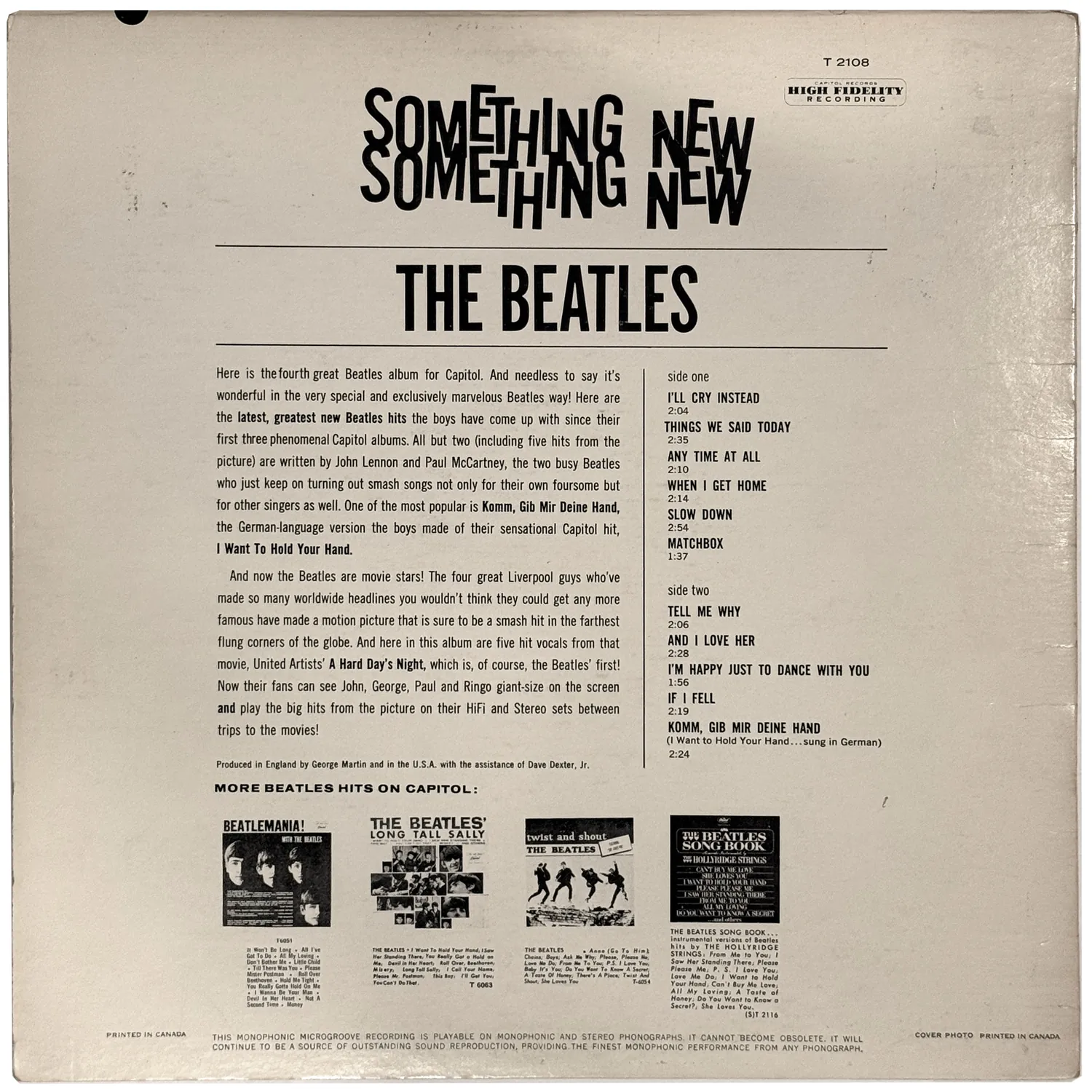
LP.2108.1.1 is the first pressing of Something New in Canada, released on Monday, 20 July, 1964. It was issued in mono only, as no stereo edition of Something New was manufactured in Canada until early-mid 1968 (see LP.2108.2.3). This pressing is recognized by its rainbow Capitol label with no brackets around the word “CANADA” in the perimeter print, by the album thumbnails presented in the wrong order on the back cover, and by its use of pressing plates supplied from the USA.
Availability
This variation was available between 20 July, 1964, and mid 1965 (for approximately 10 months) when the USA-supplied pressing plates were replaced by Canadian-cut plates (see LP.2108.1.2).
General Information
Something New was the fourth Beatles album released by Capitol of Canada, but it was the first that was not designed by the Canadian company; for the first time, it matched its American counterpart track for track, as well as its cover design (an American product released in Canada). Beatlemania! and Twist and Shout had followed the British album layouts, and Long Tall Sally had moved the Canadian line partway toward the US model. From this album on, Capitol issued the same Beatles albums on both sides of the border (source: P. Hemmingsen, The Beatles’ Canadian Discography part. 2).
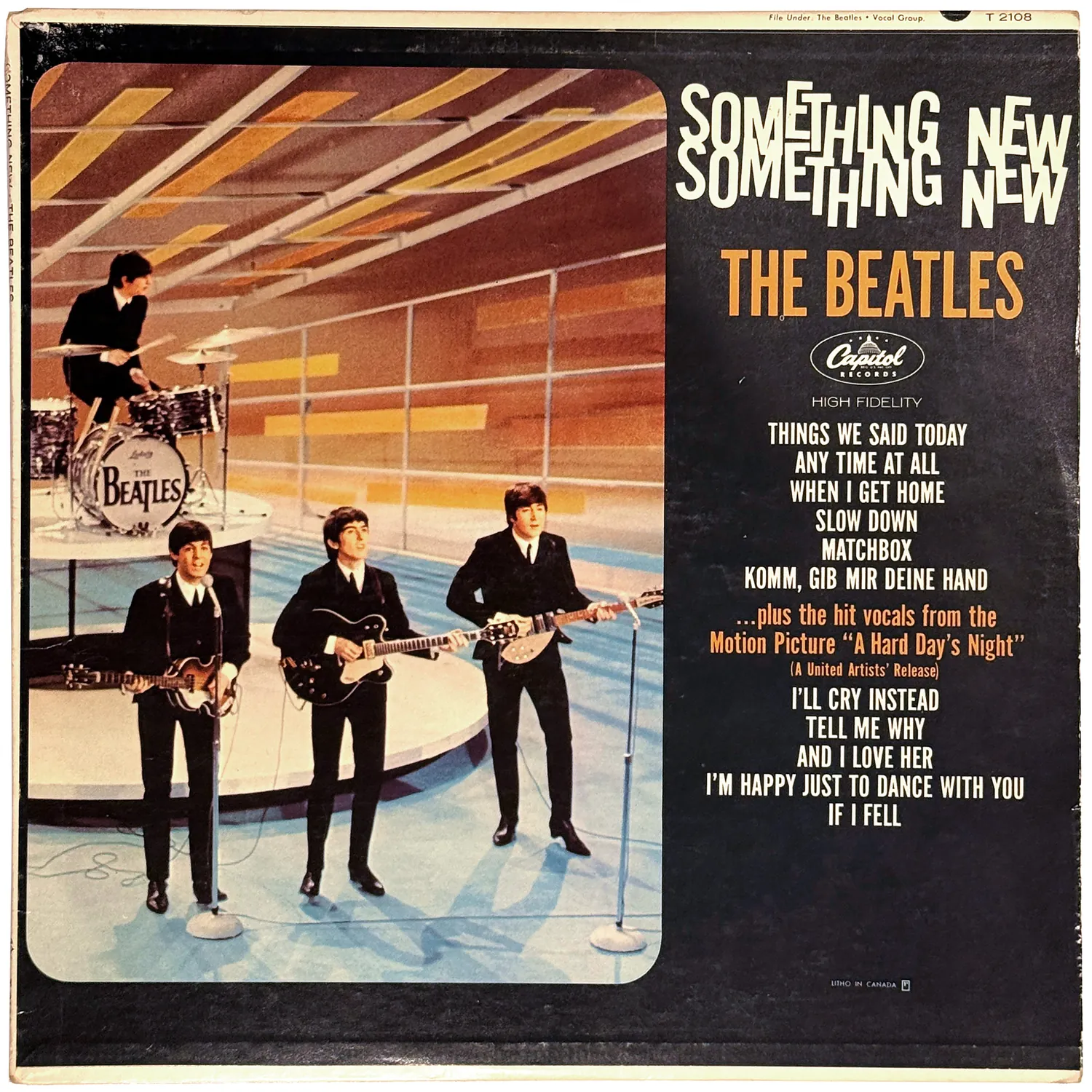
United Artists (and not Capitol) owned the soundtrack rights to the film A Hard Day’s Night, so the songs from the movie went to their UA album first (see LP.3366.UA1.1). Capitol worked around this by collecting the remaining eight tracks from the Parlophone A Hard Day’s Night LP, then filling out the running order with both sides of the British Long Tall Sally EP (Slow Down and Matchbox) and the German-language Komm, Gib Mir Deine Hand (source: P. Hemmingsen, The Beatles’ Canadian Discography part. 2).
The rainbow “no brackets” label design was found on the earliest of Beatles pressings (between November 1963 and July 1966). Canadian operations being smaller than south of the border, these early pressings are usually of high quality, sounding dynamic and their deep grooves being less prone to scratches affecting the sound.
Pressing Information
Capitol of Canada subcontracted the RCA pressing plant in Smiths Falls (Ontario) to manufacture this batch of pressings. This first batch was pressed from plates supplied from Capitol's Scranton pressing plant in the USA. USA plates are recognized by their machine stamped numbers, and parts that originate from the Scranton pressing plant feature the triangular IAM (International Association of Machinists) logo; each American plant had their own distinctive logo.
Canadian-cut plates only came into use with the mid-1965 pressings (see LP.2108.1.2). The mono masters trace back to the EMI UK A Hard Day’s Night session tapes (XEX 481/482 plus the Long Tall Sally EP and Komm, Gib Mir Deine Hand sources) via Capitol U.S.A.
The first version of LP.2108.1.1 has markings as follows:
Side 1: T1-2108-F3’’ IAM logo
Side 2: T2-2108-F5’’ IAM logo
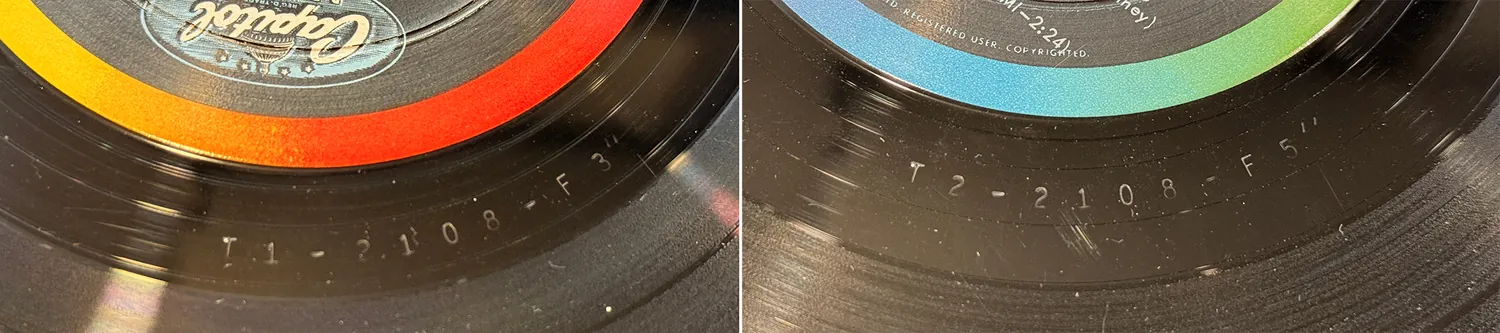
Later generations of US plates were also used extensively (and interchangeably) in 1964 and early 1965. These were marked as follows:
Side 1: T1-2108-F7 IAM logo
Side 2: T2-2108-G4 #3 IAM logo
Or
Side 1: T1-2108-F3’’ #2 IAM logo
Side 2: T2-2108-F3 IAM logo
Many different combinations of all the above matrix numbers can be found.
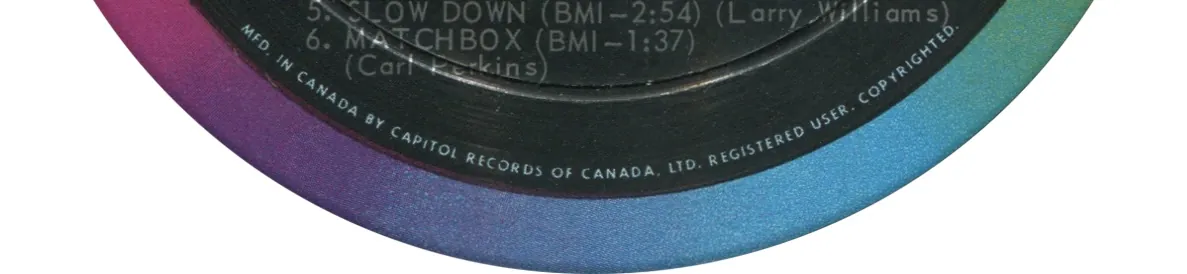
These pressings feature a 70 mm deep-groove pressing ring, a hallmark of early RCA Canadian manufacture. Labels feature the "no brackets" rainbow label (see perimeter print at the bottom of the label: "Manufactured in Canada by Capitol Records of Canada" with no brackets around the word CANADA).
Cover
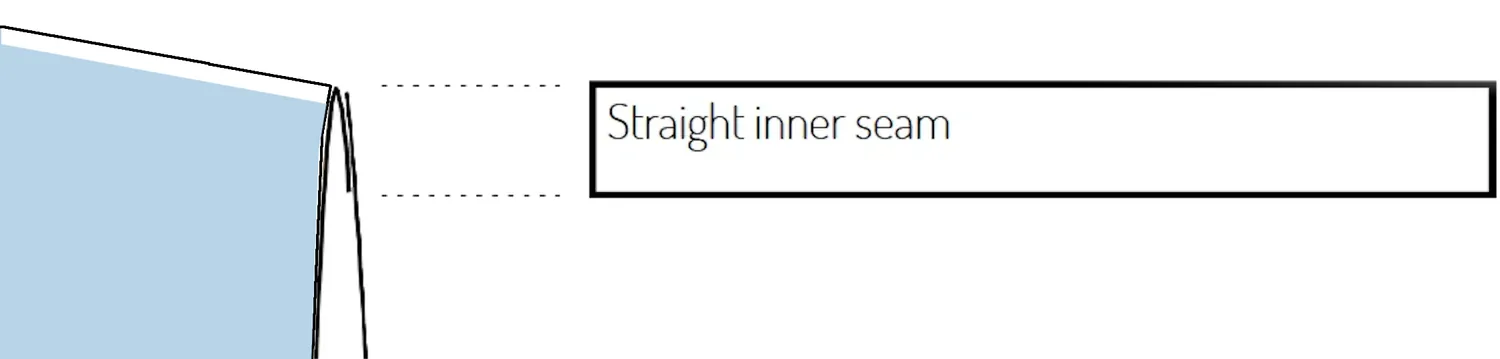
Starting in April 1964, the inner seams (the inside fold of the cardboard jacket) are cut straight (instead of curved) and measure 10 mm high.
Covers up to the mid 70s used a “front slick” construction (a larger back slick, usually printed in black and white that wrapped around the front of the cardboard cover, onto which a smaller colour front slick was glued, creating a white frame effect all around the front image).
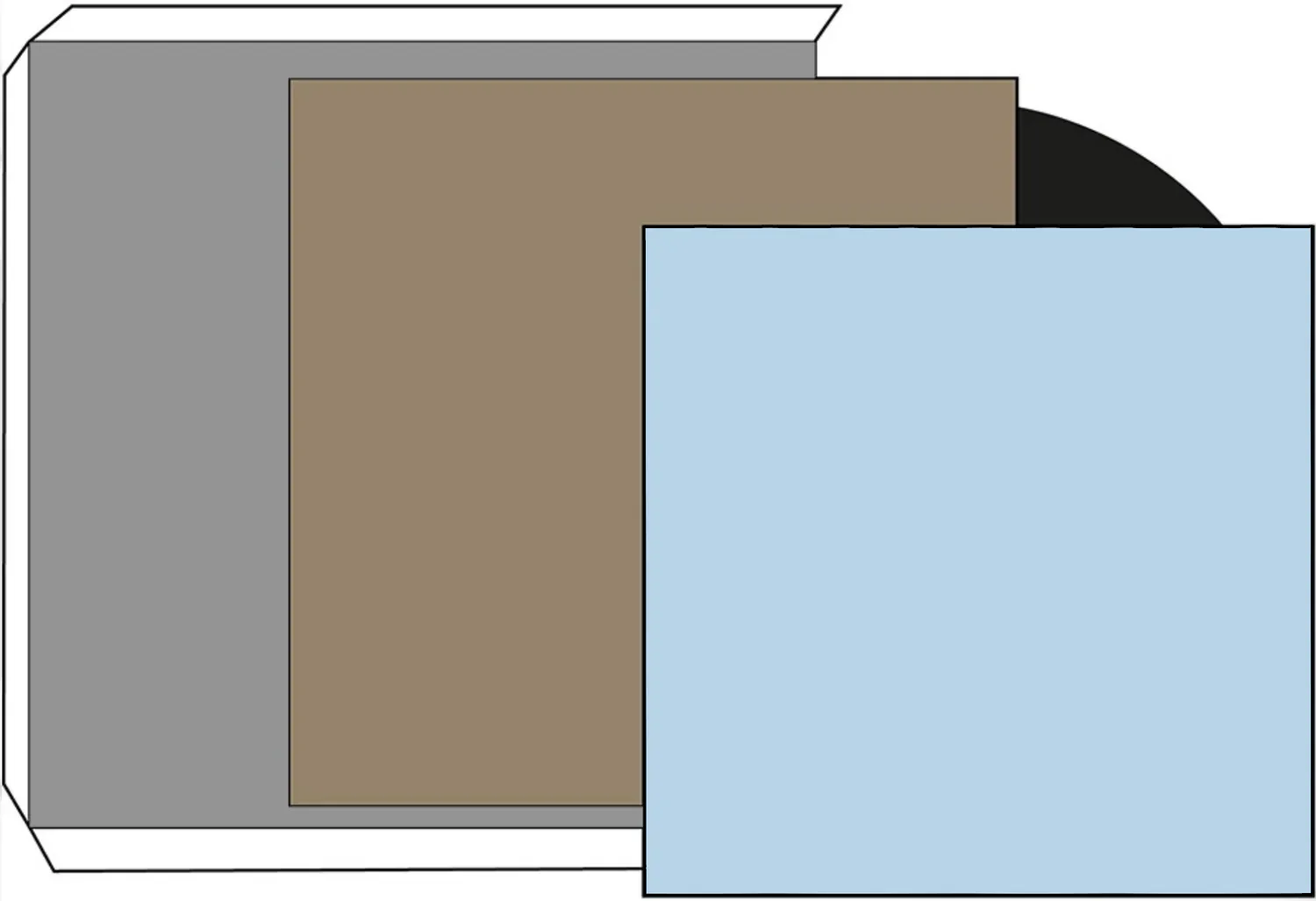
Both slicks were printed by Parr's Print and Litho in Toronto and assembled onto the cardboard frame by Modern Albums.
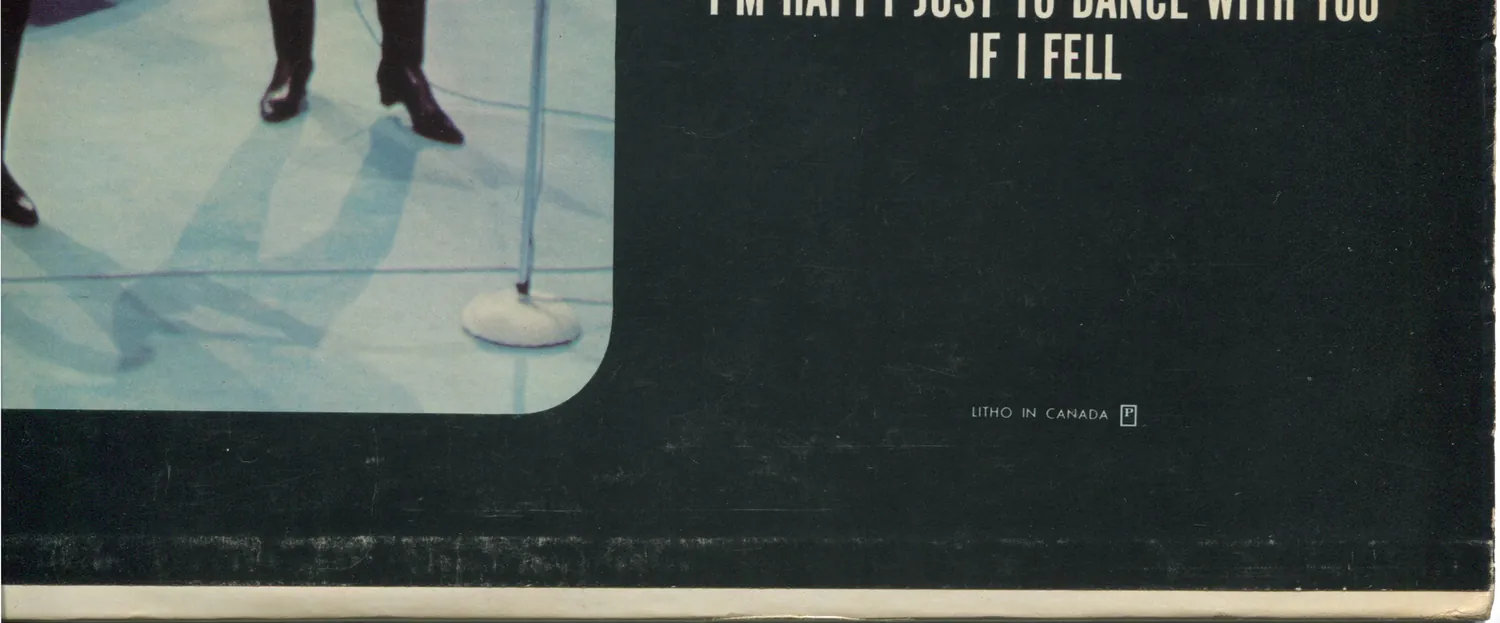
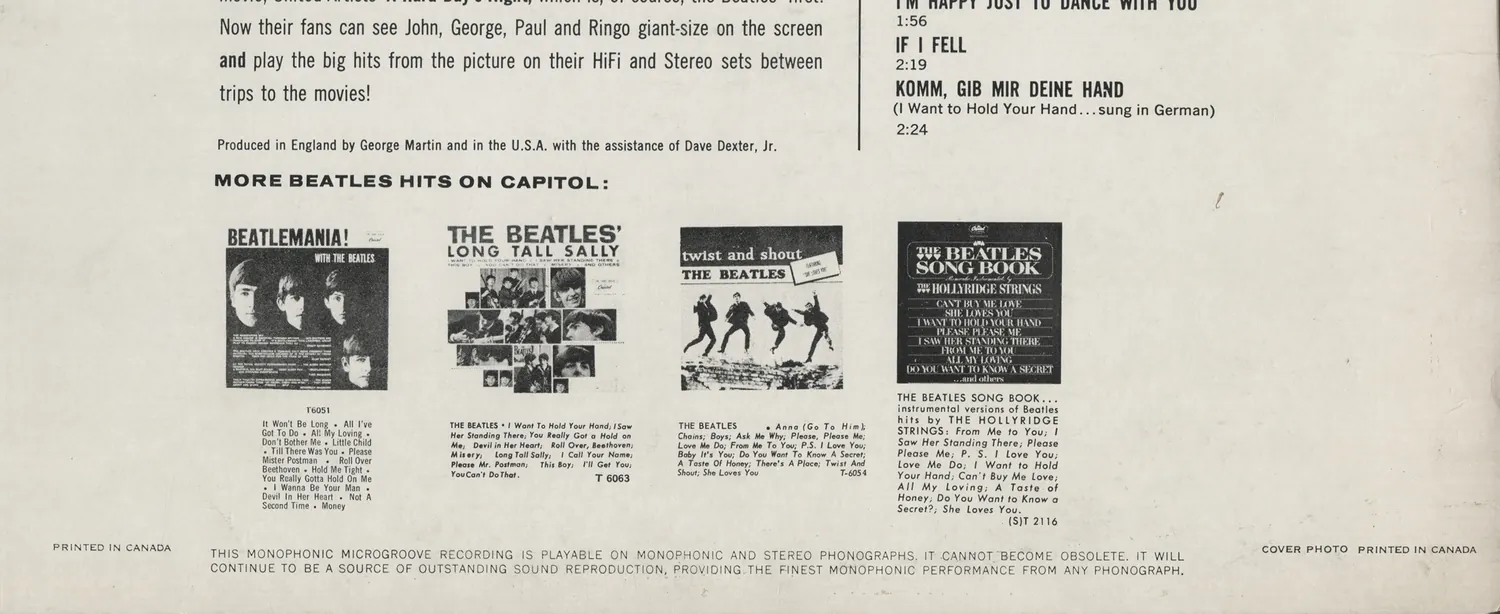
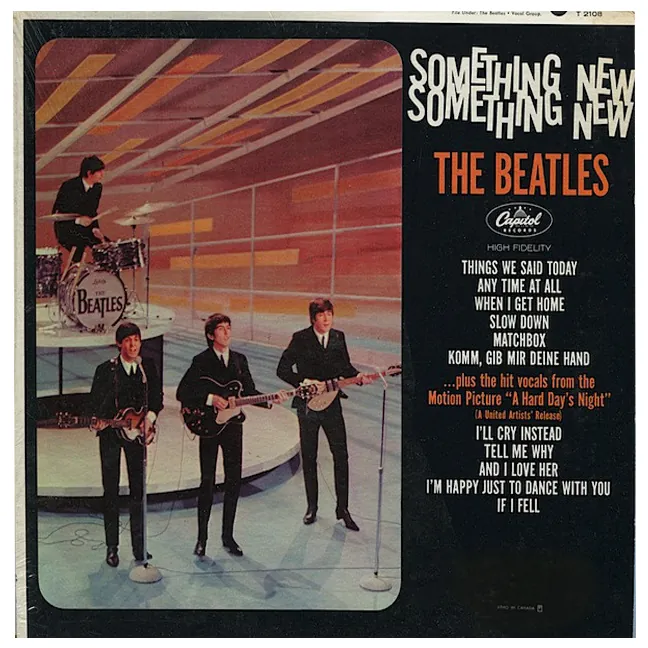
Canada used the same jacket art and catalogue number as the US edition. The one difference is the album list on the back, which was adapted for the Canadian market: Beatlemania! and Twist and Shout stand in for Meet The Beatles and The Beatles' Second Album, and Long Tall Sally was added ahead of The Hollyridge Strings' Beatles Song Book. A Canadian back cover lists four Capitol albums, one more than the American.
Early variations before late 1965 feature these albums in the wrong chronological order (Long Tall Sally before Twist and Shout), a mistake corrected on later reissues, that curiously reappeared once in the late 1960s.
Packaging
Copies from July 1964 turn up in two types of wraps: either the traditional loose poly bag with small breather holes, or the newer tight shrink wrap. After 1965, only the tight shrink wrap was used.
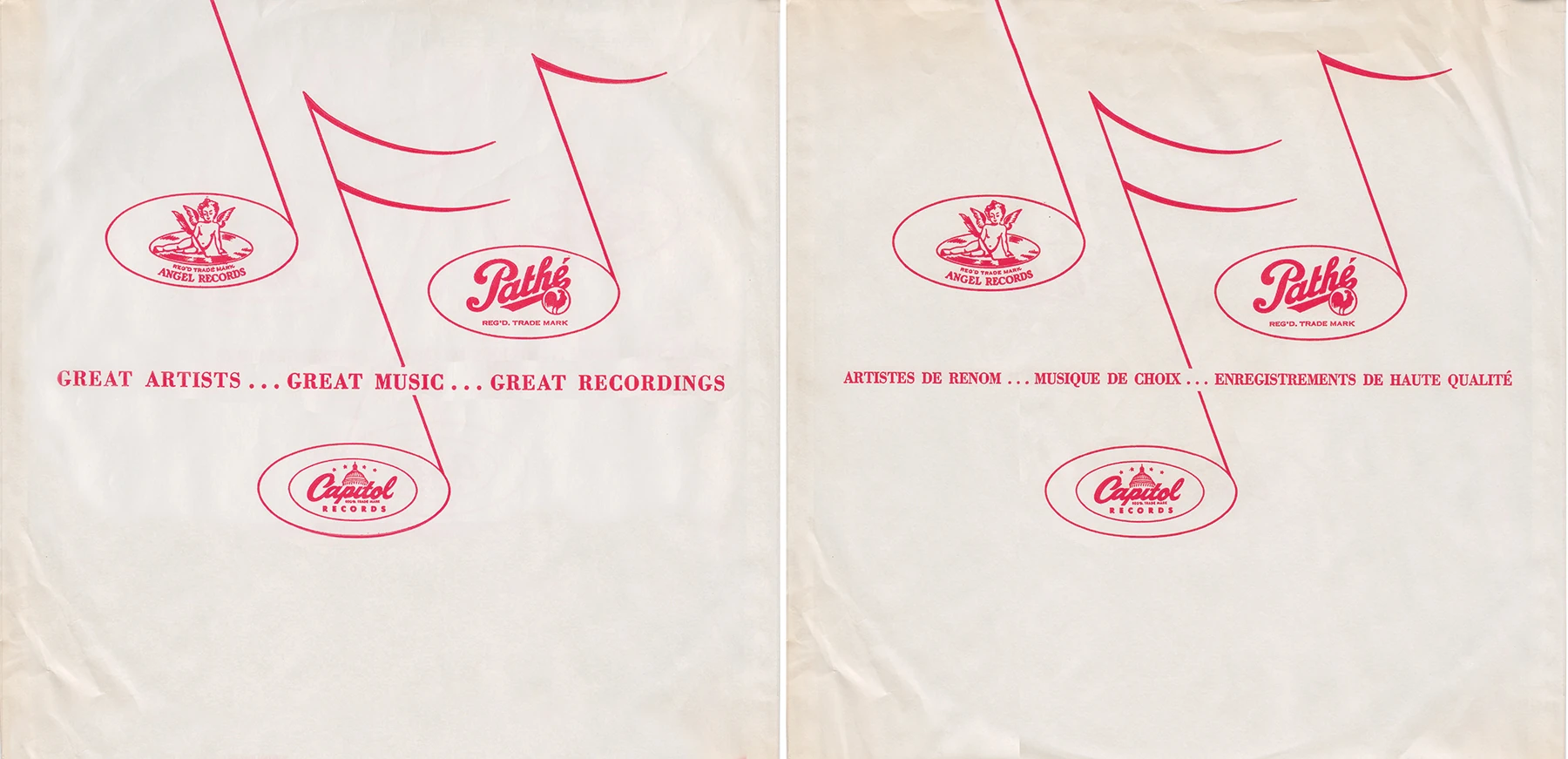
These were sold with / without a red and white Capitol / Pathé paper LP inner sleeve.
Sales
Sales records show that 63,905 copies of Something New sold in Canada in 1964 (this is variation LP.2108.1.1 only), with 9,924 additional copies in 1965 (this includes variations LP.2108.1.2 and LP.2108.1.3), 4,931 in 1966 (this includes variations LP.2108.1.3 and LP.2108.2.1) and 1,943 in 1967 (this includes variation LP.2108.2.1 only), for a total of 80,703 copies before 1968. All these were MONO copies, since the first stereo pressing was released in 1968 (source: P. Hemmingsen, The Beatles’ Canadian Discography part. 3).