← A Hard Day's Night Variations List
A Hard Day's Night
(US Format)
K7.11921.6.1 | Color J-card (NO bar code)
Black Shell with silver print (1985-1991)
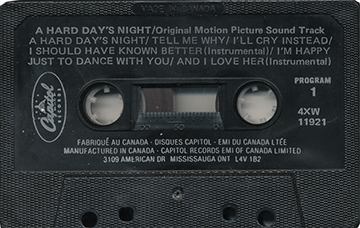
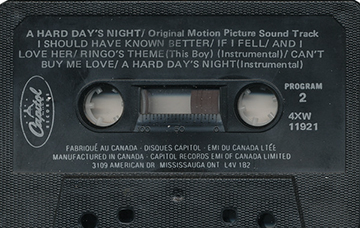
This is a unique release from Canada, and is a late 1980s incarnation on the cassette format. This variation features the new "Color J-card", a series that featured a uniquely Canadian design. Variation K7.11921.6.1 features a black shell with silver print, and NO bar code on the J-card.
Availability
K7.11921.6.1 was introduced in 1985 and remained available up until around 1991, after which the bar code was introduced on the J-card. Unlike other titles, the general numbering system for A Hard Day's Night did NOT change to the C4 format. To date, no copies have been documented with a newer C4 numbers (although the bar code was added around 1991 to the 4XW J-card; see next entry).

General Information
This cassette incarnation was on the "Color J-card (red) format", a series design by Capitol of Canada, only for Canadian Capitol cassettes, and is possibly the most common cassette variation of the album.
Pressing Information
This "pressing" was released between 1985 and remained available until approximately 1991 when the bar code was introduced. It features the same type of black shell with silver print as the previous variation. The catalog number remained "4XW-11921". The layout design is identical to earlier 1980s tapes, but the texture of the shell is different (linear pattern vs generic ruggedness). It is not known if copies of this title were ever released with the futuristic "robot font" found on other titles during this period.
Cover
The cover (or J-card) was under the new unique Canadian format: the "Color J-card design. The layout and design were generic to all Capitol releases, but the Colors of the cards were selected to match the album's artwork, making a very Colorful series when looking at them side by side.

The J-card Color of this release was RED.
Packaging
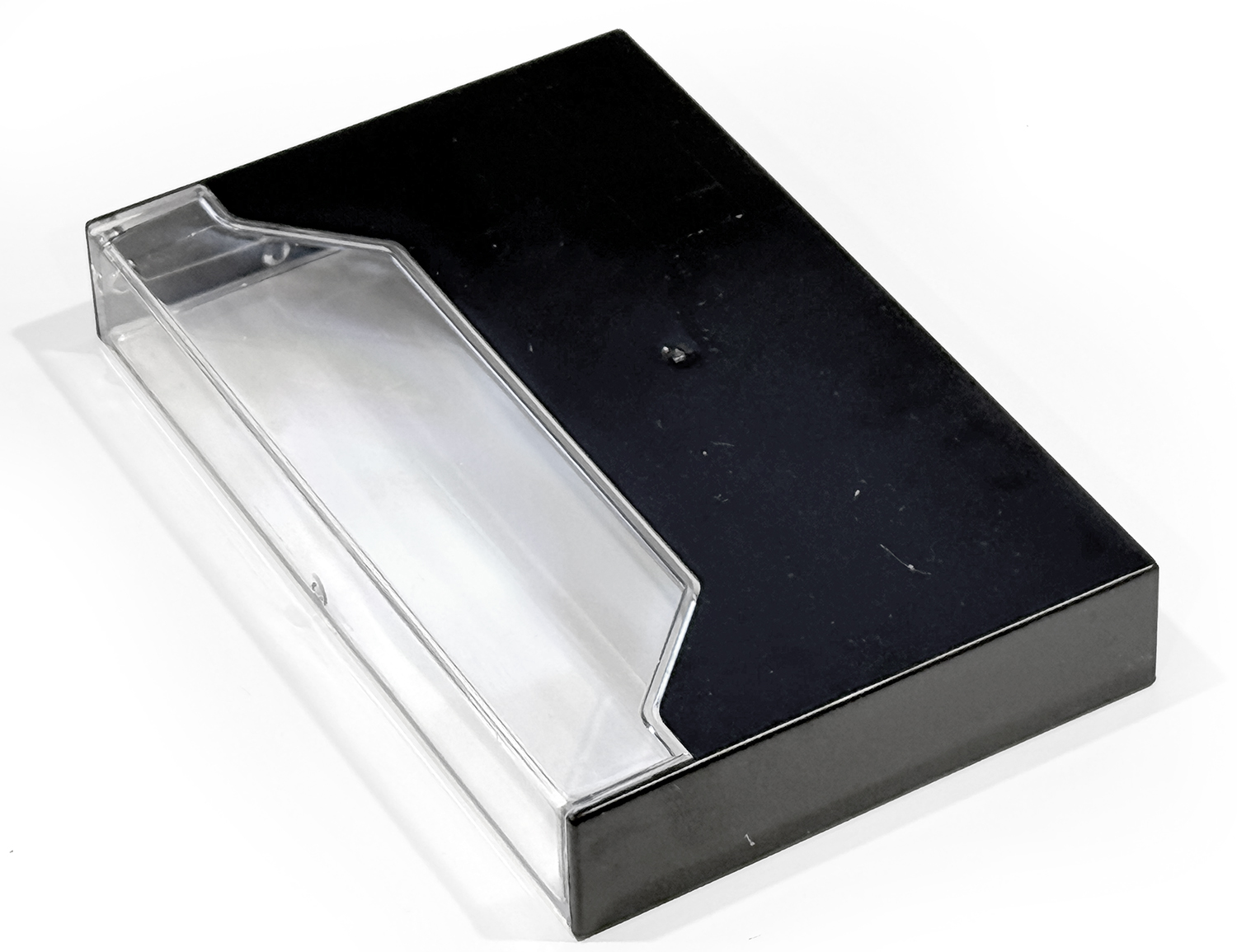
Tapes were sold in a black back jewel case , and sealed in either a firm wrap that was folded shut, or a regular heat-tightened shrink wrap.
Both types of wrapper have been verified to be used randomly between 1982 and 1995.